
Newsletter as PDF
Contact
EMB - European Milk Board asbl
Rue de la Loi 155
B-1040 Bruxelles
Tel.: +32 - 2808 - 1935
Fax: +32 - 2808 - 8265
Dear dairy farmers, dear interested parties,

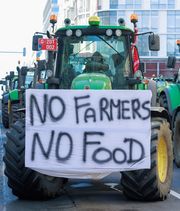
Farmers all across Europe are taking to the streets – for good reason. Tens of thousands of farmers have had enough and are letting policy-makers know about it, not with words alone, but by blocking roads in many places from Lithuania and Germany through France, Belgium and the Netherlands all the way to Italy. Enough is enough.
Farmers come by tractor to call out the continuously widening gap between the retail prices and farm-gates prices – and there seems to be only one way to make politicians listen.
We farmers do not need subsidies – what we need are cost-covering prices along with market reforms to restore market balance and guarantee an adequate income for farmers.
In our view, it is very concerning that the traditional farmers’ representatives, the grand old famers’ unions, who really should be addressing farmers’ dire economic situation, can instead be heard calling for subsidies and speaking up against an adequate voluntary reduction of production, be it for dairy products or crops.
It seems like those organizations are putting forward the arguments of processors and retailers instead of ensuring that farmers are paid a cost-covering price. Rather than securing the farmers’ livelihood – which they should be doing – they are championing an ever-growing export market. Yet, the goal should be to secure stable prices on the market so that farmers are able to meet environmental requirements. Dairy farming must be profitable to ensure the next generations can make a living in this sector.
The old saying that goes “There’s a lot of money to be made in dairy farming – as long as you’re not a farmer” needs to be reworded. The price setting structure needs to be reorganised to ensure that farmers can finally earn their fair share.
Farmers need to reclaim their primary position in the value chain; they must advance from price-takers to price-makers.
Kjartan Poulsen, President of the European Milk Board (EMB)
Open letter from the European Milk Board to the European Commission
-

- © European Union: Christophe Licoppe
President of the European Commission,
Commissioner for Agriculture and Rural Development,
We are addressing this open letter to you because, on the one hand, the situation for European farmers and food production and, on the other, for the EU as a whole has deteriorated dramatically. Not a day goes by without numerous, large-scale protests and actions by farmers all across Europe. The support among citizens for the important concerns voiced by us farmers is growing, while at the same time the faith in political and public institutions is waning.
We call on you and also offer our cooperation to bring about effective, long-term reforms in the agricultural system.
It is very important to envisage a future framework that leads to fundamental changes and reforms.
- The era of dependence on public funds,
- the era of unprofitable, loss-making food production at producer level,
- the era of farmers leaving the sector in droves and young people seeing no possibilities to enter this profession,
→ This era has reached the end of the line.
Let us use this moment, this opportunity to reform the EU agricultural system – the agricultural market – in a direction that makes it future-proof. Producers being able to earn a living from the market must be the aim of these reforms.
Temporarily calming protests with subsidies and filling only the most urgent gaps and shortfalls is not a long-term option. Public funds or tax rebates are not the answer because resources are limited. They can be used within the framework of the Green Deal as an incentive and to fund the envisaged measures – but only in tandem with reforms that reshape the market and ensure that farmers can draw an adequate income from the market. This is why, as representatives of producers, we align ourselves with those who are pushing for a future with prospects and not with all those who wish to maintain a system that is clearly broken. After all, this is what led to the problems and protests in the first place and it will continue to exploit farmers.
Let us use this opportunity to discuss real solutions and to implement them. Yes, these solutions target the market and market stakeholders. They target the distribution of margins along the value chain. A chain where money is definitely being made with foodstuffs, but none of it reaches farmers and their families. The agricultural sector must move away from dependence on taxpayer money towards a balanced sector where margins are fairly distributed between different market stakeholders. As long as this aspect is not addressed, we will simply continue down the same path, which has pushed us farmers into an ignoble situation and has led to protests in individual countries that have shaken the EU as a whole.
European elections are around the corner and the massive dissatisfaction among farmers does not only influence how they vote; it also has an impact on other sections of society. Conviction and support can only come for an EU that ensures a future for farming. If we are able to work together to develop future prospects where producer income on the market is ensured in the long‑term, it will lead to trust and thus support for the EU and its institutions. For this to happen, food production must evolve from an unprofitable sector that is, furthermore, addicted to subsidies, to a profitable one.
We can work together on a market and a sector that convinces young people to take up this profession and gives farmers the prospects they need to produce food for all of us here in Europe. If this is not tackled, then farmers – an essential pillar of our society – will be further sidelined from the EU value system, leading to all the negative consequences for them and their families as well as for food production and the EU as a whole that are part and parcel.
We would therefore like to invite you to an urgent meeting to jointly discuss the possibilities for and design of essential reforms in the agricultural sector. We look forward to receiving information about your availabilities.
Yours sincerely,

Kjartan Poulsen, EMB President
Open letter from the European Milk Board to the EU Commission of 13 February 2024
Fundamental market reforms for cost-covering prices - taxpayers' money/subsidies cannot save agriculture!
-
- © European Union: Christophe Licoppe
As the European Milk Board reported at an international press conference in Brussels on 24 January, subsidies are not going to stop the farmer protests that are taking place in numerous countries. “For those, like us, who have been following the developments in the agricultural sector over the last few years and decades, it is clear that the protests being organised now have not simply cropped up but are driven by very specific causes”, says EMB President Kjartan Poulsen. “These deep-rooted causes cannot be addressed with minor, cosmetic fixes or, worse yet, ignorance.”
Read more...Italian dairy farmers on nationwide demonstration for agricultural reform
-
- © APLP
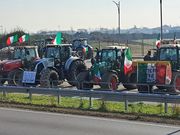
Led by an autonomous and apolitical movement, Italian dairy farmers rallied with their tractors for a nationwide demonstration on 30 January 2024. This unprecedented event ignites a movement for a "Revival of Italian agriculture", that calls for respect and recognition of the farming community's contribution.
Agricultural dialogue in Berlin: a new direction for agriculture
-
- © BDM
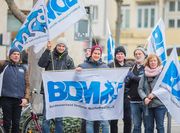
In a mass closing even in front of Brandenburg Gate in Berlin on Monday, 29 January, the agricultural sector, supported by artisans and transport companies, shone a light on the manifold problems they are facing. The far-reaching criticism by farmers did not fall on deaf ears.
Read more...Pragmatic and constructive: European Milk Board calls for urgent reforms in the agricultural sector
-

- © EMB
This year, the European Milk Board (EMB) is also present at the Green Week and is providing information about developments in the dairy sector, together with colleagues from the German dairy farmers’ association BDM and Fair Milk.
Read more...Ireland says: Goodbye 2023. The sooner we forget you, the better it will be!
-
- © ICMSA
As the first months of 2024 come to an end, the prospects and anticipation for Irish dairy farmers could not be more different to those that prevailed almost a decade ago when the European quota regime was about to be lifted. The sense of confidence that was felt by the Irish dairy sector has evaporated.
Read more...Reduction in reference milk price and controversial agriculture budget in Switzerland
-
- © Uniterre
On 20 November, the Swiss dairy sector organisation (IP Lait) announced that as of 1 January 2024, the reference price of A-segment milk would drop by 2 centimes. The reference price will thus go from 81 to 79 centimes per kg. The main reasoning: “The price decrease is mainly due to the significant reduction in milk prices in Europe.”
The drop in the reference price for A-segment milk* is a disgraceful decision! How is it possible that this country mocks its milk producers so blatantly?
Swiss dairy market in crisis: problems due to free trade of cheese with EU
-
- © Pixabay: cocoparisienne
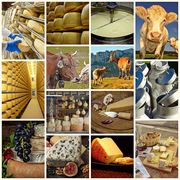
The Swiss dairy market is at risk of going off the rails. The free trade of cheese with the EU since 2007 is the cause of severe problems in Switzerland. The steadily rising exchange rate for the Swiss franc is exacerbating the situation: while the euro was worth 1.50 francs when it was introduced, today it has dropped to merely 0.95 francs. In parallel, production costs in Switzerland are constantly rising, and the milk price is unable to cover these costs.
Read more....Last-minute scramble to get Mercosur done nixes EU credibility on global warming
-

- © ICMSA
The President of the Irish Creamery and Milk Suppliers’ Association (ICMSA), Denis Drennan, has reacted to media reports of a last-minute scramble on the part of the outgoing EU Commission to conclude a Mercosur agreement by warning that any such deal will “end forever” the right of the EU to comment or develop policy in relation to global warming.
Read more...The situation in Sweden
-

- © Pixabay: Paul Moore
Sweden is seeing significant developments, particularly in the dairy sector, which is currently facing major challenges. Amidst the broader geopolitical focus on Sweden's NATO accession and agreements with the USA for access to our military bases, the agricultural sector, and more specifically dairy farming, is experiencing profound upheaval.
Read more...Let’s join forces to call for fair remuneration for sustainable agriculture!
-
- © MIG
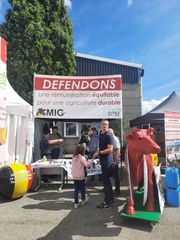
The Belgian MIG (Milcherzeuger-Interessengemeinschaft) recently carried out a survey among its members in order to find collective solutions in light of the constant decline in milk prices. This exercise drew very active and committed participation. The average age of respondents was 47 years and average milk production was 530,000 litres per year on organic farms and 655,000 litres per year on conventional farms. The aim of the survey was to tap into members’ opinion about the collective strategies to be adopted and to determine the price threshold as of which MIG should intervene.
Portugal: Valuing milk in 2024!
-
- © APROLEP
At a recent General Assembly, APROLEP's member dairy farmers voiced their concerns against the backdrop of political and economic uncertainty. They highlighted persistent high production costs, especially for animal feed.
Read more...Legal notice
European Milk Board asbl
Rue de la Loi 155
B-1040 Bruxelles
Tel: +32 2808 1935
Fax: +32 2808 8265
E-Mail: office@europeanmilkboard.org
Website: http://www.europeanmilkboard.org