
Newsletter as PDF
Contact
EMB - European Milk Board asbl
Rue de la Loi 155
B-1040 Bruxelles
Tel.: +32 - 2808 - 1935
Fax: +32 - 2808 - 8265
Dear dairy farmers, dear interested parties,
At the Agriculture and Fisheries Council of 27 April 2026, the deteriorating situation on the European dairy market was raised by several Member States. Belgium and Slovakia, with support from Bulgaria, Hungary, Italy, Lithuania and Slovenia, called attention to the growing imbalance between milk supply and demand and urged the European Commission to examine European crisis measures, including a temporary and voluntary milk production reduction scheme.
This shows that concern is no longer limited to individual countries or national associations. Across Europe, dairy farmers are warning that current market developments are pushing producers into an increasingly untenable position. In Ireland, for example, ICMSA has publicly called on the Irish government to support an EU-wide voluntary supply reduction scheme. Similar pressure is now needed across Member States, because this is a European market problem and it requires a European response.
The essentials of the proposed scheme are self-explanatory, and its effectiveness lies in its simplicity: the EU would offer milk producers compensation per litre for voluntarily reducing production during a defined period. This would send a clear signal that supply volumes are being adjusted, helping to restore balance between supply and demand and encouraging buyers to return to the market.
The question for dairy farmers across Europe is therefore clear: how do we convince the Commission and national governments that this is one of those moments when the market will not simply correct itself in time? Even if a gradual rebalancing were to come eventually, many farms do not have the time to wait for it. Milk prices in several Member States remain below production costs, while input costs, in particular fuel and fertiliser, continue to weigh heavily on farms. This is no longer a temporary loss-making phase. For many producers, the peak production months are precisely when a disproportionate share of annual income should be earned. Instead, too many farmers are working hard only to lose money or, at best, break even.
This is the reality in Ireland, but it is also the reality for dairy farmers in many other parts of Europe. There has been some marginal and tentative price recovery in certain markets, but it remains well short of what is needed to provide a sustainable margin. Without action to rebalance the dairy market, many producers will remain trapped in a situation where the market price does not reflect the real cost of producing milk.
A voluntary supply reduction scheme is a tried-and-tested instrument that has already shown it can address oversupply without relying on storage and without creating an overhang that would later threaten market recovery. The voluntary supply reduction measure introduced in 2016 proved its worth. By signalling a reduction in supply, it encouraged buyers to buy forward and helped trigger a recovery in milk prices, thereby stabilising primary production.
At a time when the agri-food sector is facing many serious and complex challenges, policy-makers should at least act where proven tools already exist. The dairy market urgently needs balance, and dairy farmers need prices that cover their costs. A European voluntary supply reduction scheme would be a practical, modest and effective step in that direction. National governments and the European Commission should now show the political will to use it.
Enjoy the rest of the newsletter, which brings together a wide range of perspectives from colleagues across Europe: the Bundesverband Deutscher Milchviehhalter (BDM) reports on its action outside the Federal Chancellery, where a symbolic pile of broken shards visualised the damage caused by years of political inaction. Arbeitsgemeinschaft bäuerliche Landwirtschaft (AbL) and MEG Milch Board criticise the approval of the Arla-DMK merger; LDM introduces a new chairman; and BIG-M looks at the worsening Swiss milk crisis and the need for producers to define their own supply management approach. FAIRMËLLECH shows how a farmer-owned brand in Luxembourg continues to support fair and cost-covering prices. The Irish Creamery Milk Suppliers’ Association (ICMSA) argues that the Common Agricultural Policy (CAP) must return to its core purpose of supporting active food-producing farmers, while Fairebel presents a tasty new product. And finally we share some recent EMB press releases, among other things criticising the unconditional approval of the Arla-DMK merger and calls for more transparency and producer rights in cooperative structures; political failures behind the devaluation of milk and farmers’ work, as well as a call to Member States to support a voluntary supply reduction scheme before record milk volumes trigger another price collapse.
We hope you enjoy reading these articles and the different perspectives they bring from across our network.
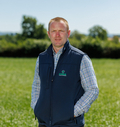
Denis Drennan, EMB Board member and ICMSA President
EMB to all Member States: Act now and support voluntary supply reduction scheme!
-
- © EMB
The European Milk Board (EMB) is raising the alarm: developments on the European and global milk market have reached a new level of escalation. Global milk volumes have increased significantly – and are continuing to rise. Such a surge is far beyond normal market fluctuations and is driving the sector straight towards a new severe crisis.
Read more...BDM: Political inaction leaves destruction in its wake
-
- © BDM
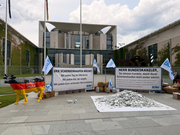
On 10 June 2026, the BDM drew attention to the ongoing crisis in the dairy market and the repercussions of years of political inaction by creating a pile of shards in front of the Federal Chancellery. As part of the protest, porcelain was symbolically smashed to visualize the destruction caused. Each individual throw represented the loss of added value suffered by dairy farms in a federal state as a result of recurring market crises. This served to highlight the economic damage the milk crisis has caused across Germany’s regions.
Read more...Switzerland: The milk crisis is coming to a head
-
- © BIG-M
The current easing of Switzerland’s milk market must not detract from the fact that the structural crisis remains unsolved. From the BIG-M point of view, it is now up to the milk producers themselves to demand and adopt a clear supply management scheme, as dairies and retailers are happy to live with the surplus situation.
Switzerland’s alpine grazing season has begun. Around 100,000 dairy cows and just as many young animals spend the summer on the alpine pastures. Most of the milk is processed into cheese directly in the mountains, thus briefly easing the situation on the milk market. The problem of excessive milk deliveries is postponed to the winter and spring. So this ought to offer some breathing space for a clear-headed approach to defining and adopting the necessary measures to avoid having to dispose of milk as biogas.
The umbrella organisation of Swiss milk producers (SMP) in Bern is struggling to find a solution, given the conflicting interests of its members. Heated discussions are to be expected. A clear sign of things to come was visible when SMP’s long-standing Managing Director was suddenly forced to step down. He had always hoped that all the stakeholders in the milk value chain, including the dairies and retailers as well as the producers, would work together to adopt a solution for the volume problem. But this hope is a mirage, because the dairies and retailers are very happy to live with the surplus situation.
Representatives from various grassroots farmers’ organisations had a meeting with Uniterre and BIG-M in Bern at the end of May. In a joint press release, they urged the SMP to take the initiative in adopting a supply management model, and to inform its milk producers about it by the end of June. How this model should then be implemented in legal terms is another story. But if the milk producers themselves don’t know what they want, who does?
Werner Locher, BIG-M secretary
20 Years of EMB: A strong voice for milk producers in Europe
-
- © EMB
This year, the European Milk Board (EMB) celebrates its 20th anniversary. At the General Assembly in Italy, milk producers from numerous European countries came together to look back on two decades of commitment to fair conditions in the dairy sector. Since its foundation, the EMB has established itself as an independent and strong voice for milk producers in Europe. What began 20 years ago as a courageous initiative by dairy farmers has today become an important political force at European level. “Twenty years of EMB show that producers can achieve real change when they stand together. Many important issues that are discussed at European level today would never have progressed this far without the pressure and work of the EMB”, explains EMB President Kjartan Poulsen.
Read more...FAIRMËLLECH – A brand in the hands of Luxembourg’s milk producers
-

- © FAIRMËLLECH
FAIRMËLLECH is a brand that has emerged from a movement against persistently low milk prices. Following the milk strike, Luxembourg’s milk producers joined forces and, in 2011, founded a cooperative to safeguard fair, cost-covering milk prices for its members. Today, 15 years later, the brand is carried by around 60 dairy farms in Luxembourg. It is still the milk producers themselves who hold responsibility for the cooperative and for the brand.
Read more...Fairebel launches Boudin Blanc with Fair Milk
-
- © Fairebel
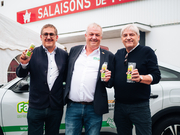
Faircoop and Les Salaisons de Malmedy have joined forces to launch Boudin Blanc or white pudding with Fairebel’s Fair Milk. This 100% Belgian collaboration combines artisanal know-how, regional roots and better remuneration of milk producers.
Read more...Back to basics: why Europe needs a CAP that works for farmers
-
- © ICMSA
The Irish Creamery Milk Suppliers’ Association (ICMSA) argues that the Common Agricultural Policy (CAP) has drifted away from its original purpose: supporting food-producing farmers so they can keep affordable, high-quality food flowing to European consumers. Instead of trying to make CAP carry both food security and environmental policy, ICMSA calls for CAP to return to meaningful direct support for active farmers, with environmental objectives funded separately through a Common Environmental Policy.
Read more...World Milk Day 2026: dairy farmers show political failure in the milk market
-
- © BDM
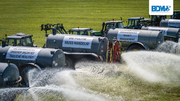
With a provocative protest before World Milk Day (1 June), dairy farmers from the German Bundesverband Deutscher Milchviehhalter (BDM) and the European Milk Board (EMB) are making publicly visible what, in the farmers’ view, has been politically ignored for years: the systematic devaluation of farmers’ work and the performance of their animals.
Read more...Mandatory contracts in France: It’s not all bad!
-
- © APLI, Adrien Lefèvre
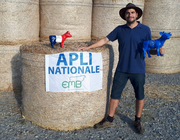
All contracts are not worth talking about but those that guarantee a price that truly covers production costs, include review clauses and define supply volumes and duration can strengthen the position of producers. The limits of the EGAlim law in France (designed to balance commercial relationships between agricultural producers, processors, and retailers), nonetheless, show that a contract-based system remains imperfect: complex calculation formulas, undervalued costs and the growing disparity among producers demand keen vigilance.
Read more...EMB criticises unconditional EU approval of the merger between Arla Foods and DMK
-

- © Pixabay: Wolkenkrieger
The European Milk Board (EMB) criticises the EU’s approval of the merger between Arla Foods and the DMK Group without binding conditions for the new cooperative structure. The merger creates one of the largest dairy corporations in Europe and, in the EMB’s view, reinforces a worrying trend in the European cooperative sector: ever larger and increasingly non-transparent structures in which milk producers’ influence is diminishing. Therefore, milk producers call for clear conditions for cooperative mergers and stronger producer rights.
Legal statement by AbL and MEG Milch Board on Arla-DMK merger: farmers’ concerns are ignored
-
- © AbL
Farmers’ organisations are outraged: the EU Commission has unconditionally approved the merger of Arla and DMK, thus paving the way for Europe’s largest dairy cooperative. AbL and MEG Milch Board criticise the failure to take the farmers’ concerns into account, and are now demanding detailed monitoring and evaluation of the consequences for milk suppliers.
Read more...Young, forward-thinking dairy farmer is new Chairman of Danish LDM
-
- © LDM
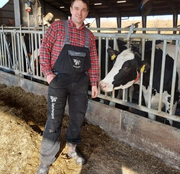
Jørgen Schmidt is the successor to Kjartan Poulsen as LDM Chairman. The 37-year-old producer is the third generation on his family’s farm near Branderup in Southern Jutland. The farm has 245 Holsteins and 135 hectares planted with clover grass and corn. Jørgen has a wife and three small children. The day-to-day running of the farm means a lot to him and will continue to form a big part of his everyday life.
The focus of LDM’s activities continues to be on working for solid and profitable milk production in Denmark.
Legal notice
European Milk Board asbl
Rue de la Loi 155
B-1040 Bruxelles
Tel: +32 2808 1935
Fax: +32 2808 8265
E-Mail: office@europeanmilkboard.org
Website: http://www.europeanmilkboard.org