
Newsletter as PDF
Contact
EMB - European Milk Board asbl
Rue de la Loi 155
B-1040 Bruxelles
Tel.: +32 - 2808 - 1935
Fax: +32 - 2808 - 8265
Dear dairy farmers, dear interested parties,

The livelihood of European dairy farmers is threatened by agricultural goods produced under unequal standards and subject to insufficient controls of quality, health and environmental standards upon entering the European Union (EU). Politicians must take action.
For Europe’s dairy farmers, the EU-Mercosur agreement is a step in the wrong direction. Access to agricultural markets is used as a bargaining chip for industrial trade interests, whereas dairy and meat production are sensitive sectors where price pressure undermines farms’ long-term resilience.
The Mercosur trade agreement’s shortcomings are of a structural nature:
Unequal competition is inherent: Differences in production conditions and in the enforcement of environmental, health and labour standards translate into different costs. If imports produced under weaker or less strictly enforced rules gain market shares, European farms that must comply with higher standards pay the price – as do consumers, who may end up with lower-quality products.
Controls are not credible at the scale required. The EU cannot claim to preserve “high standards” while allowing market flows that are only partially and inconsistently checked in practice. If we want standards to be meaningful, enforcement must be effective, predictable and properly resourced.
The “opportunity for farmers” narrative is misleading. Even in export-oriented dairy regions, farmers do not automatically benefit from more trade. The gains often accrue elsewhere in the value chain, while additional imports into sensitive sectors increase overcapacity and exacerbate price pressure.
The European Milk Board (EMB) calls on the European Commission to:
Reject the Mercosur agreement to the extent that it threatens sensitive agricultural sectors and undermines European production standards.
Immediately strengthen import controls for agricultural products from third states, with effective checks of health, environmental and social standards.
Publish transparent data on real market flows and assess the impact of imports on farm viability, the agricultural sector’s resilience and rural livelihoods.
Treat farmers’ interests as essential in trade policy, not as an afterthought or a tool to balance other objectives.
Prevent overproduction and stabilise markets, so that fair prices are possible and standards remain economically sustainable.
Trade policy, however, is only one part of the problem. Within the EU, farmers are too often relegated to being price-takers at the end of the chain. This is why the current review of the Unfair Trading Practices (UTP) Directive by the European Commission matters. Rules must be clear, breaches must result in real consequences, and the system must not reward those who squeeze producers by skirting vague legal boundaries. The EMB, together with the European Coordination Via Campesina (ECVC) and other partners, is working hard on this.
And very important: in the context of the current devastating price development, the EMB’s call upon the European Commission is very urgent – activate the voluntary supply reduction scheme immediately to halt the downward price spiral. Dairy farmers are ready to reduce production as part of an EU-wide coordinated programme to rebalance the market. Without swift political action, Europe risks to have another structural breakdown in dairy production, with severe consequences for regional food security and rural livelihoods.
Kjartan Poulsen, EMB President
EU must activate voluntary volume reduction in the dairy sector NOW!
-

- © EMB
European dairy farmers raise the alarm amid an acute and dramatic crisis – markets are flooded, prices are collapsing. Milk prices have been falling for months, pushing farms into severe existential difficulties and making it clear that a voluntary volume reduction must be activated immediately at EU level by the European Commission, before more farms are forced to shut down.
Read more...EMB Presidents issue strong warning at SIA over impending milk crisis
-
- © Silvia Däberitz, EMB
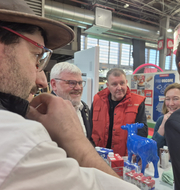
Without voluntary volume reduction, there is no way forward! At the Salon International de l’Agriculture (SIA) in Paris, EMB President Kjartan Poulsen and EMB Vice-President Boris Gondouin issued a strong warning about the dramatic escalation of the situation on the European milk market. Many farms are once again operating far below cost coverage and are increasingly facing an existential threat. This is not a sustainable model for Europe’s milk production.
Read more...Isn’t it time for a total strike where we stop delivering all of our products?
-

- © Pixabay
Tensions due to agricultural and trade policies are being felt throughout the European Union. This text from our French members provides a very tangible overview of the reality on the ground and how these massive challenges are perceived by producers.
Published on 1 February on Facebook
Swiss dairy market in the doldrums
-
- © IP Lait
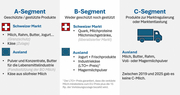
The Swiss dairy market is facing its umpteenth structural crisis due to an increase in milk production following favourable weather conditions. The result: Switzerland reported a surplus of 5% in September, which increased to 10% by the end of 2025.
Read more...EMB position becomes officially acceptable in Switzerland
-
- © Pixabay:fil magic
The dairy market in Switzerland has reached a new low. Milk is being processed into butter by the truckload and skimmed milk has to be disposed off in biogas facilities because of insufficient capacity for milk powder production. There is only one option left: the milk volume must go down. But how?
Read more...Belgian Olympian goes off piste – driven by the values of an agricultural cooperative
-

- © Geoffrey Fritsch
After his Olympic qualification, Belgian skier Armand Marchant decided to chart his own course, off the beaten track. Instead of only working with traditional sporting sponsors, he decided to partner with Fairebel – a cooperative owned by Belgian farmers known for its Fair Milk products.
Read more...MIG on the frontline for dairy farmers
-
- © Belga
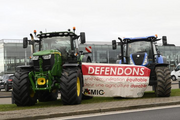
Major mobilisation and strong concerns have come forth from the dairy sector in recent months. MIG would like to recap the current key challenges and the actions undertaken to defend the interests of dairy farmers.
Large-scale farmer protests were held in December and January to oppose the free-trade agreement with Mercosur. MIG participated actively alongside numerous farmers. This agreement poses severe threats for our farms: unfair competition, lower prices for agricultural products, less strict environmental and social standards, weaker European food sovereignty. MIG remains fully mobilised to push for a clear rejection of this agreement and the implementation of fairer, more sustainable trade policies.
In the meantime, the drop in milk prices is a pressing issue for producers, putting dairy farms on the line. Income has reduced sharply, while production costs have stagnated or increased.
Considering this worrying situation, MIG calls for the urgent activation of a dairy market regulation mechanism to stabilise prices, guarantee cost-covering remuneration for producers, prevent yet another milk crisis and secure the future of the sector. Effective regulation is imperative to ensure the survival of our farms.
Governance of dairy cooperatives: need for professionalisation
MIG has also noted increasing difficulties in managing certain dairy cooperatives. Executive boards do not always have the necessary skills to manage what have become complex structures. MIG suggests increased support in the form of external experts to provide key competencies needed: economists, accounting experts, management and strategy specialists. This assistance would help improve transparency, financial management and decision-making viz-a-viz producers.
Another major source of concern is the corporate grabbing of agricultural land for carbon offsetting. This trend implies higher land prices, more difficult land access for farmers and a loss in food sovereignty. MIG warns against the long-term consequences of these practices and calls for a strict framework to protect agricultural land and maintain its key function of food production.
Against this challenging backdrop, unity and producer mobilisation are essential. MIG will continue to actively defend the interests of dairy farmers before policymakers, the European institutions and economic stakeholders.
MIG (Milcherzeuger-Interessengemeinschaft) team
No flooding of our markets – No to Mercosur dumping and uncontrolled imports
-

- © ec.europa.eu
The European Milk Board asbl (EMB) strongly urges the European Commission and national governments to critically reassess the current developments surrounding the EU–Mercosur free trade agreement and to place the protection of farmers at the centre of their decisions.
Read more...EFSA: Call for data on the use of 3-NOP in ruminants
-
- © Vanessa Langer
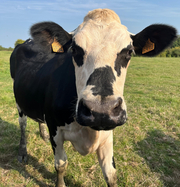
The European Food Safety Authority (EFSA) has launched a public call to submit data on the use of 3-nitrooxypropanol in ruminants. EFSA has been mandated to prepare a scientific opinion on the safety of the feed additive for the target species under Regulation (EC) No. 1831/2003.
Read more...Legal notice
European Milk Board asbl
Rue de la Loi 155
B-1040 Bruxelles
Tel: +32 2808 1935
Fax: +32 2808 8265
E-Mail: office@europeanmilkboard.org
Website: http://www.europeanmilkboard.org