
Newsletter as PDF
Contact
EMB - European Milk Board asbl
Rue de la Loi 155
B-1040 Bruxelles
Tel.: +32 - 2808 - 1935
Fax: +32 - 2808 - 8265
Dear dairy farmers, dear interested parties,
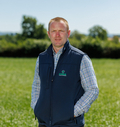
Ireland’s dairy sector has long been a key pillar of the country’s agricultural economy combining both deep-rooted tradition and ‘state-of-the-art’ innovation. And yet, today, Irish dairy farmers are facing unprecedented challenges: increasing production costs, tightening environmental regulations, and volatile milk prices are putting significant pressure on their livelihoods. Recent extreme weather conditions have only intensified the situation, demonstrating just how vulnerable farmers are to factors beyond their control.
These difficulties in Ireland are not isolated. Across Europe, dairy farmers are grappling with similar issues. Whether in France, Germany, Lithuania or Spain – farmers are facing rising production costs, fluctuating farm-gate prices, and a policy environment that often demands more while offering little in terms of fair market structures. In many regions, it is becoming increasingly clear that the survival of family farms – the backbone of our European agricultural model – is under severe threat.
It is precisely because these challenges are shared that solidarity and coordinated action at the European level are essential. As the European Milk Board, we must continue to emphasise that only a comprehensive approach to sustainability – one that encompasses economic, social and environmental pillars – can secure the future of dairy farming in Europe.
Fair prices that cover production costs and proper market regulation that actively deals with destructive volatility and corporate margin-grabbing are prerequisites for some degree of stability and an easing of the pressures on what’s left of the EU’s indigenous family farm structure. But above all, we desperately require political recognition of the strategic importance of family farms that must be placed at the centre of European agricultural policy. Recent examples, such as the successful implementation of voluntary production reduction schemes and national legislation prohibiting the purchase of foodstuffs below production cost, show that positive change is possible when the right instruments are employed.
As we look ahead, the EMB will continue to advocate for measures that strengthen the economic foundation of dairy farming and enable farmers to meet societal and environmental expectations without compromising their livelihoods. Whether in Ireland, Denmark, Portugal or Poland, our demands remain the same: a fair income, market transparency, and a viable future for the next generations of dairy farmers.
Together, we are stronger.
Denis Drennan, member of the EMB Executive Committee
Arla/DMK merger creates new cooperative giant
-
- © EMB
EMB statement: “We have to talk about cooperatives! What cooperatives are – what they are not – and what they pretend to be!”
AbL speaks out against the planned merger of Arla and DMK
-
- © AbL
The German small farmers’ association (Arbeitsgemeinschaft bäuerliche Landwirtschaft, AbL) has expressed strong criticism about the planned merger of Arla Foods, a Danish-Swedish dairy cooperative, and the German DMK Group. AbL especially deplores the lack of transparency and predicts potential disadvantages for producers.
Read more...Arla Foods acquires the DMK Group: do we need a fundamental overhaul of the milk market?
-
- © BDM e.V.
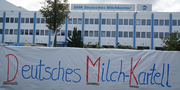
As Germany formed a new coalition government and farmers were waiting to find out who the next Federal Minister for Agriculture would be, milk producers were discussing the upcoming merger/acquisition of Arla Foods and DMK.
Read more...Uniterre, BIG-M, BBK and BZS call for a sweeping reform of IP Lait
-

- © Uniterre, BIG-M, BBK and BZS
Multiple Swiss farmers’ organisations have called into question the role and legitimacy of the interbranch organisation IP Lait through a parliamentary motion. Their demand: a fairer governance system, more transparency in contracts, and milk prices aligned with production costs.
The Kolly motion (available in French, German and Italian), submitted on 20 March 2025, is a reaction to the many years of mismanagement by IP Lait, the dairy interbranch organisation. A hasty, thoughtless press release by IP Lait on the Bilaterals III (negotiations between Switzerland and the EU on a third bilateral trade package; editor’s note) was the last straw. The Kolly motion calls for an end to the compulsory fees that must be paid to this organisation that claims to defend the interests of Swiss milk producers. It is, nonetheless, clear that this does not solve the issue of inadequate milk prices. It would be better to change the functioning and composition of IP Lait. Milk producers have had enough of receiving a milk price that is well below their production costs and of being the only ones to have to bear market risks. Despite the 400 million Swiss francs spent by the Confederation on the milk market, the sector is unable to conclude milk contracts that offer dairy farmers prospects.
Against this backdrop, Uniterre, BIG-M, BBK (Bernisch Bäuerliches Komitee) and BZS (Bäuerliches Zentrum Schweiz) demand that the universal application of compulsory fees awarded to IP Lait expiring on 31 December 2025 only be renewed under the following conditions:
- Standard contracts must indicate the milk volume in kilos and price for A-segment milk for at least three months.
- The A-segment price must be fixed according to a floor price system based on production costs and ex-farm prices.
- Collection must prioritise A-segment milk for the first 180,000 kilos.
- Delivery of B-segment milk must be voluntary, without repercussions in case of non-delivery. These demands derive from the “Improve the terms of the dairy interbranch organisation’s standard contracts” motion (available in French, German and Italian) adopted by the Council of States in 2019 and the National Council in 2020.
- Milk producers must make up 50% of representatives in IP Lait; the remaining 50% of seats must be allocated to the buyers, i.e. milk traders, cheese makers, the dairy industry and retailers.
- Milk producer representatives must themselves be dairy farmers.
- Milk producer representatives at IP Lait must not have conflicts of interests. Representatives cannot also be members of management boards of companies involved in the collection/sales/processing of milk.
- Milk producer representatives must be chosen in an open, transparent, democratic process that guarantees that every milk producer has the right to cast their vote.
- Decisions by the IP Lait board and delegates assembly must be taken by simple majority to avoid vetoes by individual sectors.
If IP Lait does not comply with these conditions, the request to extend the universal application of compulsory fees must be rejected at all costs. Otherwise, we will not hesitate in asking the Parliament to correct this position by IP Lait.
Joint press release by Uniterre, BIG-M, BBK and BZS published on 10 April 2025 entitled “Stirring up the hornet’s nest!”
Switzerland: A postage stamp for fair milk prices!
-
- © BIG-M
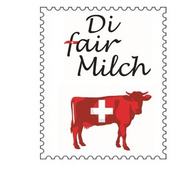
Great initiative in Switzerland: the Di fair Milch cooperative has come up with an innovative way to raise awareness about fair milk prices. A special postage stamp featuring Faironika, the EMB cow in Swiss colours, that makes every letter a tiny ambassador for cost-covering producer prices.
Read more...Swedish dairy farmers at a crossroads
-
- © Ulrik Isleborn
The milk price is currently acceptable for most Swedish producers. A few dairies are unable to match the price offered by the market leader, but there is a general hope among farmers that milk prices will at least remain at their current level.
Read more...The dairy sector and the future (of the) Green Deal
-

- © EMB, Roberto Cavaliere
While a potential revision of the European Green Deal offers both challenges and opportunities, the possible – positive and negative – impacts on the dairy sector would be significant. Producers could face higher costs as a result of adopting greener practices, investing in sustainable technologies, and meeting stricter regulations.
Read more...Proposal for a European regulation on the transport of unweaned calves – a threat to dairy farming in Europe
-
- © Vanessa Langer
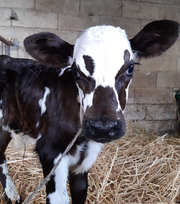
The European Parliament and the Council of the European Union wish to amend the legislation on animal transports. According to the draft regulation, it will no longer be possible to transport calves younger than five weeks and weighing less than 50 kg. This measure would have severe economic and practical consequences for dairy farmers.
Read more...Legal notice
European Milk Board asbl
Rue de la Loi 155
B-1040 Bruxelles
Tel: +32 2808 1935
Fax: +32 2808 8265
E-Mail: office@europeanmilkboard.org
Website: http://www.europeanmilkboard.org