
Newsletter as PDF
Contact
EMB - European Milk Board asbl
Rue de la Loi 155
B-1040 Bruxelles
Tel.: +32 - 2808 - 1935
Fax: +32 - 2808 - 8265
Dear dairy farmers, dear interested parties,

Since the EMB was founded fifteen years ago, we have been struggling – sometimes more, sometimes less successfully – to generate a revenue that would allow us and our families a decent life. 2022 was a better year – despite the fact that our production costs sky-rocketed. In Belgium, we had farm-gate prices of almost 60 cents per litre. Why is it then that over four months, this price paid to producers has fallen by 30% and is now at 36 cents per litre? While it is true that our price is closely linked to butter and milk powder exports, they have reduced by only 10% (4,564 euros/t for butter, 3,375 euros/t for milk powder). Something doesn’t add up.
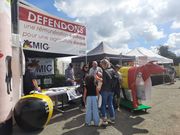
At the recent milk producer fair in Battice, MIG used its traditional bottle of milk to show that there was a cost coverage shortfall of 8.4 cents per kilo in the second quarter of 2023 (see MIG article below).
The closer we get to the fateful date of 2030 under the Green Deal, the clearer it is becoming that milk and meat represent half the agricultural production value in Belgium. However, over the last two decades, the dairy herd has shrunk by 30%, the number of farmers has reduced by more than 60% and farmer income is inadequate and unstable. Furthermore, the many challenges raise real questions about the future of livestock farming: climate change, animal welfare, biodiversity protection and preserving landscapes...
With so many open issues, the future of our farms is uncertain. Do we need to champion productivism and implement new technologies? Should we highlight the quality of our products? Should we focus on feed autonomy, on-farm processing, the creation of real producer cooperatives that work to establish Fair Milk projects in their countries? What repercussions will these changes have on our profession as livestock and dairy farmers?
In Belgium, MIG participated in a public survey looking to decode the expectations and difficulties faced by young people entering the farming sector. I think that our different countries across Europe are facing the same issues. Generational renewal and passing on farms are the biggest concerns in the agricultural sector. I think these two striking figures illustrate my point: 68% of farmers are over 50 years old and only 22% know who will take over from them. When talking about the future of our farms, perhaps the EMB should call on the European Commission to set a cap on how much agricultural land industry giants can acquire, so that they can no longer grab our lands while claiming that they themselves have become farmers (some even claim to be ACTIVE farmers) and are now eligible for CAP subsidies. I would like to mention the agricultural land grabbing in Germany by Aldi (more than 30,000 hectares) as well as in Belgium by the Colruyt group. But there are many other examples out there of financial models that have nothing to do with primary agricultural production.
It is our duty to put an end to this immediately if we want our profession to be upheld in its entirety as we know it today. Let’s remain committed and show civil society that with their support, we can take things in our own hands and offer sustainable, fair, viable and eco-friendly agriculture that protects the environment for our future generations.
Guy Francq, member of the EMB Executive Committee
8th European Fair Milk Conference celebrates the commitment of farmers and honours contributions to social sustainability
-

- © EMB
Something that should be commonplace in the dairy market has in fact become a rare sensation: for a few years now, Fair Milk has made it possible for farmers to earn a decent living. This brand founded in 2006 in Austria now puts socially sustainable products on supermarket shelves for consumers. At the Fair Milk Conference held in France, FaireFrance was joined by other Fair Milk projects and the European Milk Board asbl (EMB) to celebrate the progress of this important brand founded by farmers.
Read more...Spanish law: paying above the cost of production
-
- © Pixabay: Peggy_Marco
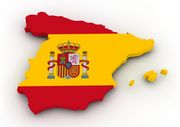
In 2021, Spanish law makers introduced a novelty to stop the destruction of value in the food chain. The Spanish agricultural organisation COAG (Coordinadora de Organizaciones de Agricultores y Ganaderos) gives us an overview.
The main cultural shift introduced by the recent amendment to the Act of 2021 is the concept of paying above the cost of production to avoid the destruction of value in the food chain. This aspect has been extensively demanded by organisations representing producers and it is a key factor for the sustainability of the European model of agricultural production. Amending the trade behaviour in the chain is obviously no easy task, but a necessary one for the future of agriculture and livestock farming in the European Union, along with many other measures that must be taken in this regard.
In particular, the Act specifies that the price set in the supply contract which has to be paid to a primary producer or a group of primary producers must always be higher than the total costs borne by the producer or the actual cost of production. This definition includes all costs borne to develop their professional activity. The following items can be taken into account, inter alia: the cost of seeds and plants, fertilisers, plant protection, pesticides, fuel and energy, machinery, repairs, irrigation, animal feed, veterinary fees, amortisations, interest on loans and financial products, agricultural contractors and manpower, work done either by employees or the producers themselves or by members of their family unit.
The production costs borne by each operator along the chain, not just the producers, are worked out individually and specifically. There is no one-size-fits-all or general definition of the costs per sector, per production field or per link in the chain, be it from either a public body or a private entity.
This is a clear progress, albeit it has not been possible to turn the tables immediately. Nevertheless, the foundations have been laid to reach this ambition. The mere fact that the buyers have started to consider that the producers they are buying from incur a number of costs that make up the purchase price is a breakthrough. Until recently, this matter was not considered in the agreed price, but was neglected in the food chain’s trade negotiations and relations. Moreover, this tool enables bargaining, up to a certain point, and whistleblowing by the producer in the event of a breach by the buyer.
The supervisory authorities both on a state level (AICA) and in the autonomous communities (CCAA) carry out inspections within their remit, both ex officio and in response to reports, leading to cases being opened to punish failure to comply with the prohibition of value destruction in the chain. In the first half of 2022 alone, for instance, eight claims involving retailers were filed on grounds of value destruction in the dairy chain.
Moreover, the prohibition of value destruction applies to every link in the food chain: each operator must pay the upstream operator immediately preceding it a price equal to or above the production cost borne. In addition, the sale at a loss at the last stage in the chain, i.e. to consumers, is forbidden, so that retailers will not be able to either offer or sell food products at a price below the one paid to purchase them. Failure to comply with this ban introduced by the Act can be subject to an administrative penalty imposed by either AICA or the CCAA, each within its sphere of responsibility.
In the current market context and as intervention measures have mostly disappeared from the EU public policies, these paradigm shifts have become necessary and must be applied throughout the European single market, through national policies and amendments to EU regulations.
Alvaro Areta García, Technical Officer, Coordinadora de Organizaciones de Agricultores y Ganaderos (COAG)
German Ministry of Food and Agriculture aims to support dairy farmers - first step in the right direction
-
- © AbL
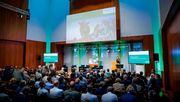
The Federal Ministry of Food and Agriculture (BMEL) organised a conference on the “Future of dairy farming in Germany” on 31 August in Berlin. In addition to the BDM, the AbL also participated in this conference and provides their evaluation of the event, which they believe expressed support for dairy farming.
Read more...Future of dairy farming in Germany: challenges and opportunities in focus at Berlin conference
-
- © BDM
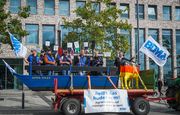
The conference organised by the Federal Ministry for Food and Agriculture on 31 August in Berlin concluded with the first indications from the ministry in favour of strengthening dairy farming. The BDM engaged actively in discussions with representatives from the dairy industry, research, NGOs, trade and with farmers themselves. We also expressed our criticism of agricultural policy to date with an action in front of the conference venue, and presented our expectations of this conference by publishing an eight-point position paper.
Read more...Crisis in the Alps: Swiss dairy farmers fight for survival and fairness
-
- © Uniterre
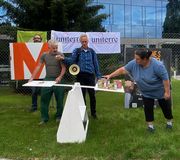
Things are far from idyllic in the Swiss alps! Producers continue to struggle and their numbers keep dwindling. In 2022, some 300 dairy farms definitively shut their doors. There are only 17,600 farms still hanging on – we would not have dared imagine this figure ten years ago, so it is safe to say that we are facing hard times.
Read more...The Lithuanian dairy sector faces mounting challenges
-

- © LPGA
The situation for milk farmers in Lithuania continues to deteriorate. Over the past year, the Lithuanian dairy sector has witnessed a worrying decline, notably a reduction of 7,500 dairy cows, equating to a 3.3% decrease. At the same time, the number of operational dairy farms saw a steep drop of 11%, totalling a loss of 2,500 farms. This downward trend has continued with a 2.5% drop in milk deliveries. Worse still, despite this drop in milk deliveries, there has been no corresponding increase in milk prices. To draw a comparison: the current milk purchasing price is about 30% lower than it was in 2022. From January to August 2023, the income of milk producers in Lithuania was a staggering 120 million euros lower than during the same period of last year.
Read more....Reduction in milk price: the gap between costs and producer income is growing yet again
-
- © MIG
A fair milk price for producers is one that covers all their production costs, offers them decent pay for the work done and ensures that they can put aside savings. It is plain to see that the milk price in 2023 is not fair.
Read more...The growing wolf population in Denmark: challenges and responses
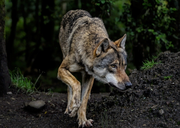
Denmark's wolf population has recently reached unprecedented numbers, shifting the balance in the country's ecosystem. For decades, the fox was Denmark's largest predator. However, in recent years, packs of wolves have firmly established their territories, both inside and outside the designated wolf areas in the western regions.
Read more...Legal notice
European Milk Board asbl
Rue de la Loi 155
B-1040 Bruxelles
Tel: +32 2808 1935
Fax: +32 2808 8265
E-Mail: office@europeanmilkboard.org
Website: http://www.europeanmilkboard.org