
Newsletter as PDF
Contact
EMB - European Milk Board asbl
Rue de la Loi 155
B-1040 Bruxelles
Tel.: +32 - 2808 - 1935
Fax: +32 - 2808 - 8265
Dear dairy farmers, dear interested parties,

For many years now, European agriculture has been facing a growing and deeply concerning issue: the ageing of our agricultural workforce. At first glance, one might consider this to be the course of nature, assuming that the market economy will somehow correct the imbalance. However, this approach underestimates the gravity of the situation and the long-term risks it harbours for society. Our farmers provide our food, a basic need that sustains life and society as a whole.
The European Milk Board (EMB) has consistently highlighted the need for a comprehensive review of agricultural policies, particularly regarding fair payment for farmers. The current system, heavily reliant on subsidies, offers no real prospects for the next generation. Young people are dissuaded from entering the farming sector because the financial outlook is bleak. Without the ability to earn a living wage, support a family, and build a future, farming lacks appeal. This is not just a problem for individual farmers or rural communities; it is a pressing issue of national security across Europe.
Therefore, the EMB strongly urges the European Commission to collaborate with us on developing a sustainable agricultural framework that ensures fair margins for producers. This means creating a market environment where farmers can earn a living from the market, rather than relying on unpredictable and often insufficient subsidies. A predictable and fair income is essential to attract young people into agriculture, ensuring the sector’s long-term viability.
If we fail to act decisively now, we risk the irreversible erosion of the agricultural sector. This would not only lead to a decline in food production in Europe but could also contribute to a broader international food crisis. The implications of such a crisis would be severe, affecting food security, economic stability, and the well-being of millions. It is only through a comprehensive and fair agricultural policy that we can secure a future for farmers, ensuring that the next generation is equipped and motivated to continue the vital work of feeding Europe.
Photo: Lita Millere, Latvian press agency (LETA)
Guntis Gūtmanis, Chairman of LOSP (Lauksaimniecības organizāciju sadarbības padome), member of the EMB Executive Committee
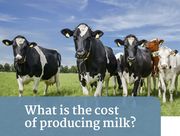
No surprise: latest EU production cost figures for the dairy sector in 2023 report a cost coverage shortfall yet again
-
- © EMB
When it comes to ensuring a fair position for producers in the value chain, transparency in terms of costs and prices plays a very big role. The Agriculture and Food Chain Observatory (AFCO) recently held its first meeting in order to (hopefully) create the framework for exactly that. The methodologies already exist in the dairy sector. For many years now, the BAL (Office for Rural Sociology and Agriculture) has been regularly producing cost and price calculations using a representative methodology. For example, the latest EU figures have just been published: the average cost coverage over five years was only 88 percent.
Read more...ICMSA dismiss von der Leyen’s ‘new’ strategy for agriculture until “fundamental binary decision” is addressed
-
- © ICMSA
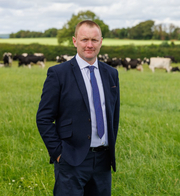
The President of ICMSA, Denis Drennan, said that Ursula von der Leyen’s remarks in which she referenced “a new European strategy for our agriculture and food sector” could not be taken seriously until such point as the Commission finally chooses to either fundamentally reform margins in the food supply chain or increase direct supports to farmers without attaching expensive environmental conditions. The Commission was guilty of “disabling political cowardice”.
Read more...Strengthening the position of farmers in the supply chain
-
- © AbL
On 17 July 2024, the European Commission launched the Agri-Food Chain Observatory (AFCO). The first meeting of the Member States, the EU Parliament and various associations made it clear that the EU Commission and some pioneering Member States such as France, Spain and Belgium are seriously interested in strengthening the position of farmers in the food supply chain. There is European backing for a contractual obligation before delivery to safeguard the milk supply.
An allegedly new butter mountain in Switzerland: who stands to gain?
-

- © Pixabay: Jacqueline Macou
Uniterre has sharply criticized the butter imports of recent years. And rightly so! It is unacceptable for milk producers to have to carry the burden of poor management by the Interbranch Organisation Milk (BO Milch or IP Lait) with a reduction in the price for milk and an increase in the share of B-milk, as explained by Stefan Kohler (BO Milch).
Read more...Switzerland: serious consequences of misjudgement
-

- © BIG-M
Hochdorf, the largest milk powder producer in Switzerland, has entered a deal to sell its struggling operative subsidiary to a private equity company. The Hochdorf holding has been granted a provisional debt-restructuring moratorium. The main cause consists in a misjudgement made at the time when the milk quota was abolished in 2009.
Read more...Campaigns for the German Raiffeisen Day and Article 148 CMO
-
- © BDM
The two-day German Raiffeisen Day 2024 held in Berlin in mid-June saw detailed discussions about the future prospects for Germany and for the agricultural sector, with contributions among others from the leader of the Christian Democrats (CDU), Friedrich Merz, focusing on the thesis that the “culture of cooperation between business and politics doesn’t work (anymore)”.
How ironic, when you think that it is the association of “cooperatives” that is turning all the wheels to strengthen the interests of big business, while forgetting farmers in the process. “All power to the farmers” was once the founding idea of Friedrich Wilhelm Raiffeisen (1818-1888), the father of the cooperative concept, whose ideas and ideals are taken ad absurdum today by his own association. We took a figurative approach to expressing this problematical reality in Berlin on the Spree river and on land.
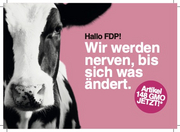
Postcard campaign on Article 148 CMO
“I’m going to make a nuisance until things change!” This was the exalted claim of the German liberal party (FDP) for the European elections. Given the dismissive attitude of the FDP towards implementing Article 148 CMO in Germany, this was reason enough for us to change the campaign slogan into “Hello FDP! We’re going to make a nuisance until things change”. This was combined with the appeal to come out in favour of Article 148 and grant us the possibility of contracts being concluded prior to milk deliveries – all printed on a charming postcard. The postcard was then sent to all FDP politicians responsible for agriculture on the federal and state level throughout Germany.
German government adopts agricultural package
The three parties in the German coalition government have reached agreement on an agricultural package to give farmers more planning security and to relieve the pressure on farms. Tax burdens on farmers are to be reduced by smoothing out the tariffs. Similarly, changes are to be introduced to the conditionalities and eco-schemes in the Common Agricultural Policy. More effective measures should be taken against unfair trading practices to strengthen the position of farmers in the supply chain. Smoothing out the tariffs should help to compensate for varying taxation burdens in the two three-year periods (2023-25 and 2026-28). The volume is estimated at around 50 million euros per annum.
The CAP conditionalities are being defused. In future, checks and sanctions will only be planned for farms with more than 10 hectares of agricultural land. Similarly, the obligation to keep 4% of arable land as non-productive area is waived. With regard to “unfair trading practices”, it is forbidden to soften up unfair trading practices on the black list. Furthermore, the time limits will be eliminated from the rules also for suppliers in the “dairy” product group with turnover of up to 4 billion euros. The agricultural package was adopted by the lower house of the German Parliament (Bundestag) in early July and will go through the upper house (Bundesrat) in late September. Consultations on other important topics will continue after the summer recess, for which proposals are expected from the ZKL (Commission on the Future of Agriculture).
Bundesverband Deutscher Milchviehhalter e.V. (BDM)
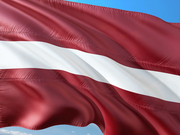
Latvian farmers on the brink: Guntis Gūtmanis discusses looming challenges and unfair trading practices
-
- © Pixabay: Jorono
As Latvian farmers brace for tough budget negotiations this autumn, Guntis Gūtmanis (LOSP, Latvian Agricultural Organisation Cooperation Council) warns against the potential for significant unrest if government support should falter. Gūtmanis stresses that everyone understands that the budget situation is tight. Therefore, the associations are not asking for an increase of funds at the moment. However, if existing support to farmers were to be reduced, farmers “will be in the streets, they will be in the Ministry of Finance.”
LOSP’s message: “Don’t provoke the farmers!”
Legal notice
European Milk Board asbl
Rue de la Loi 155
B-1040 Bruxelles
Tel: +32 2808 1935
Fax: +32 2808 8265
E-Mail: office@europeanmilkboard.org
Website: http://www.europeanmilkboard.org