
Newsletter as PDF
Contact
EMB - European Milk Board asbl
Rue de la Loi 155
B-1040 Bruxelles
Tel.: +32 - 2808 - 1935
Fax: +32 - 2808 - 8265
Dear dairy farmers, dear interested parties,
Recent developments in European agricultural policy have given us reason to be cautiously optimistic. During the International Green Week, a big trade fair held annually in Berlin for processors and marketers in agriculture, horticulture and various food industries, the new Commissioner for Agriculture, Christophe Hansen, made statements that suggest he understands the critical role of agriculture – not only in ensuring food security but also in combating climate change. The Commissioner highlighted several priorities that could bring meaningful change to our sector.
First, he recognises the need to update the Common Agricultural Policy (CAP). Farmers across Europe, young and old alike, are all too familiar with the growing burden of bureaucracy. Time spent in front of a computer is time off the fields. A simplified and more predicable CAP would free farmers to focus on what truly matters: producing high-quality food.
Second, the Commissioner has proposed a financial safety net for farmers to address the challenges posed by climate change, volatile markets, and external shocks. Recent years have demonstrated how vulnerable our sector is to droughts, floods, and heat waves. At the same time, geopolitical events such as the war in Ukraine, trade disputes, and the Mercosur deal have shown how deeply political decisions can affect farmers’ livelihoods. A robust safety net is crucial to shield farmers from such risks and ensure the resilience of our food supply.
Third, Hansen has acknowledged the urgent need to ensure fair prices for farmers. Without fair and predictable incomes, the farming sector struggles to attract skilled young people who are vital to its future. The EMB has long emphasised the importance of fair prices. Our Market Responsibility Programme (MRP) is a proven instrument to counteract market crises in the dairy sector. Likewise, the production cost analyses carried out by the BAL (Bureau for Rural Sociology and Agriculture) are indispensable for understanding and improving the economic realities of dairy farming. We will gladly share these insights with the Commissioner to help build a sustainable financial framework for agriculture.
Finally, the Commissioner’s commitment to addressing climate change is a welcome recognition of the critical role farmers play in this fight. Agriculture is on the front lines of climate impact, bearing the brunt of extreme weather events, while also working to implement sustainable practices. Supporting farmers in these efforts through financial security and fair pricing is essential for a future in which European agriculture can thrive.
European dairy farmers are proud to produce some of the finest food in the world. But we must be able to earn a decent living to continue doing so. Only then can we inspire and equip the next generation of farmers to take on the immense challenges and opportunities that lie ahead.
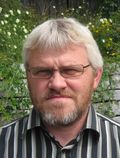
Kjartan Poulsen, President of the European Milk Board (EMB)
Fairkoperativ meets with new European Commissioner for Agriculture
-
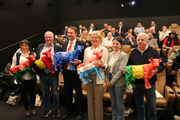
- © D’fair Mëllech: Pit Bosseler
On 13 January, Fairkoperativ, a cooperative of dairy farmers in Luxembourg, hosted Minister of Agriculture Martine Hansen and the new European Commissioner for Agriculture, Christophe Hansen, for a screening of the documentary “Trainée de poudre”.
Read more...BDM symposium with focus on sustainable milk production: challenges, opportunities and future prospects
-
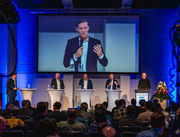
- © BDM
Following a year of intensive debate, on 18 January 2025, the federation of German dairy farmers (BDM) held its traditional symposium at the International Green Week in Berlin. Under the heading “Sustainable development of our farms: who sets the course?”, representatives from science, the dairy industry and practitioners discussed the central challenges for the milk sector.
Read more...Swiss milk producers supporting butter and cream exports: how do you justify that?
-

- © Paul Brennan, Pixabay
Just before the Christmas holidays – on 17 December 2024 – a very interesting article was published in the “Schweizer Bauer” trade magazine called “Butter imports: here’s how much money was made”. It looked at the millions earned by the Swiss Confederation in customs duties from the thousands of tonnes of butter imported to Switzerland between 2020 and 2023.
Read more...Ireland and dairy policy perspectives in 2025
-

- © ICMSA
As the new year has rolled in and farmers have settled back into our spring calving pattern, where we calve most of our cows in February and March to coincide with our grass-grazing season, Irish farmers have many thoughts on their minds – much more than the impending arrival of calves and damage from the latest storm. Here are the main issues concerning the members of ICMSA for the coming year.
Read more...MIG calls for a joint mobilisation at European level: the only way to make our voice heard against the nefarious EU-Mercosur agreement
-

- © ec.europa.eu
Alongside several Walloon and European agricultural organisations, MIG is taking a firm stance against the free-trade agreement between the European Union and the Mercosur countries. This agreement poses a direct threat to agriculture, the environment and food security in Europe by nullifying all sustainability efforts.
We call on all agricultural and consumer organisations to mobilise together against this agreement, to defend sustainable farming in Europe and to safeguard the interests of farmers and consumers.
Impact of the EU-Mercosur agreement
Farmers faced with unfair competition: While the EU imposes strict standards on its own farmers, it is opening the door to products that do not uphold these European standards. We do not believe that mirror clauses will be effective, especially because of the real challenges linked to monitoring and implementing them. Cheaper products from Mercosur countries, produced in a barely regulated, intensive production model at much lower cost, present direct unfair competition against European farmers. This imbalance threatens the income and weakens the economic viability of European farms.
Incompatible with climate goals: Increasing agricultural exports from the Mercosur countries, especially beef, will further accelerate deforestation in the Amazon and thus climate change. What’s more, more long-haul transport of goods produces additional pollution. This contradicts Europe’s climate goals and the commitments undertaken within the context of the Green Deal.
A blow to food sovereignty and food security: By making Europe dependant on global markets for its food supply, this agreement endangers food sovereignty and the resilience of our local supply chains. Furthermore, farming in the Mercosur countries uses pesticides and products like growth hormones that are banned in Europe. This poses a health risk to European consumers and is detrimental to food security in Europe.
We call upon the farming sector to mobilise for a sustainable future
Faced with these challenges, a joint mobilisation of Europe’s agricultural stakeholders is essential. This is what we propose:
- Local and European coordination, with common demands: organise simultaneous actions in as many European countries as possible to engage with policy-makers, raise awareness among citizens and demand that the EU-Mercosur negotiations be halted.
- A fair and sustainable trade policy: call for a trade policy that protects European farmers and consumers and respects the principles of sustainable development.
We strongly believe that the strength of a collective movement is the only way to influence political decisions. In this context, staying silent would be tacit approval of this agreement with Mercosur, along with all its negative consequences. In Belgium, agricultural organisations beyond the dairy sector have already come together to organise joint actions against this agreement. Together, we issue a clear demand: stop the EU-Mercosur negotiations and defend sustainable, fair agriculture in Europe. We hope that this movement will resonate with other agricultural organisations within the European Union.
Let’s act together to say NO to Mercosur!
Let’s act together to make our voice heard for a sustainable and fair future for farming!
Christian Wiertz, President of Milcherzeuger-Interessengemeinschaft (MIG)
Switzerland: dwindling acceptance for milk price segmentation
-
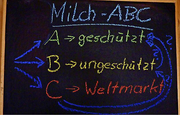
- © Schweizer Bauer
The fact that dairy farmers are very dissatisfied has been known for a long time. The Centre for Development and Environment at Bern University has now presented a study that takes a more detailed look at the reasons behind this dissatisfaction.
Read more...Dairy farmers demand that Chancellor Scholz takes up a clear position: contractual obligation strengthens position of farmers in the value chain
-

- © AbL
Representatives of several farmers’ associations have criticised Federal Chancellor Olaf Scholz in an open letter. They accuse him of stepping on the brakes in the negotiations currently taking place in Brussels to introduce a European contractual obligation for the milk sector. Together they called upon Scholz to take a clear, resolute stance at the EU Agriculture Council at the end of January in order to improve the negotiating position of dairy farmers on the European level.
Read more...Legal notice
European Milk Board asbl
Rue de la Loi 155
B-1040 Bruxelles
Tel: +32 2808 1935
Fax: +32 2808 8265
E-Mail: office@europeanmilkboard.org
Website: http://www.europeanmilkboard.org