Newsletter as PDF
Contact
EMB - European Milk Board asbl
Rue de la Loi 155
B-1040 Bruxelles
Tel.: +32 - 2808 - 1935
Fax: +32 - 2808 - 8265
Dear dairy farmers, dear interested parties,
As many of you know, the European Milk Board (EMB) was created more than fifteen years ago to denounce the end of milk quotas in Europe. In parallel, the EMB proposed other solutions to maintain a regulatory system of some kind that is necessary in order to avoid overproduction and to ensure decent prices (see proposals of our MRP – Market Responsibility Programme).
In our opinion, these milk quotas simply needed a refresh to improve their effectiveness and thus equity among producers in each European country. The EMB decided to tirelessly lobby European policy-makers as well as our cooperatives, the industry and farmers' unions (especially large ones) that, of course, shoulder a major responsibility regarding this issue. In the beginning, our objective was to work on policies with policy-makers, and that is something we continue to pursue.
But the liberalism that has taken control for decades now among many of our stakeholders makes it very difficult for us to gain headway with our ideas. We believe that they are essential to ensure a future where producers are active all across Europe and can make a decent living from their work, supplying quality milk to consumers and dutifully safeguarding the environment.
Very quickly at the EMB, and since the beginning of our actions, we engaged in debate and disputes with many of our detractors and have developed the concept of Fair Milk in many countries. Simply put, our objective was to link the largest possible number of producers in every country, in a North-North fair project, in order to have a wide range of milk products that are sold at a decent producer price in every shop.
As active producers for decades, we can attest to the fact that the situation has severely deteriorated when it comes to producer remuneration. I am purposely talking about remuneration and not turnover. If only many of my fellow dairy farmers would take note! I insist on this because it is absolutely essential and the root cause of everything!
The objective of Fair Milk is to take back control of the added value generated by us and that has been taken, even stolen from us for too long. In short, we need to go back to being peasant farmers – that both produce and sell. In this way, our power and our strength will increase exponentially, especially if we all align with the same ideas, the same prices, the same brand – all at a national scale. What we need is short supply chains at national level!
But in order to guarantee longevity, sustainability and most importantly equity, this brand must belong to the farmers themselves. Otherwise, we would be back to what we have always experienced with our large cooperative dairies and their cursed private supply chains, or worse yet, what we have to deal with in France – a clever little businessman that appropriates our concept by signing some contracts with farmers who, like many, are looking for added value. However, over time, they see things for what they are and simply end up losing out due to additional intermediaries only interested in profits for themselves and their businesses. But we know well that this does not work, least of all for the farmers!
The brand must belong to farmers because it gives them ownership, they feel it, they live it, they make it buzz, and no matter where they are, they will promote it without even thinking about it. This is already the experience of the hundreds of farmers who have created their Fair Milk brands, but we would like to take this concept to the next level by multiplying the number of members by hundred, by thousand, or by the total number of farmers and beyond! By adopting the concept of Fair Milk, farmers essentially gain autonomy over their farms. In this way, they are no longer the third wheel when it comes to generating value from their own production.
Regulating production across Europe with good distribution of volume by country and by farmer, and joining the ranks of national Fair Milk projects en masse: these are two key steps to ensure that in future, we will see young people joining dairy farming in large numbers and that, finally, dairy farmers will be happy to be part of this sector.
In terms of reinforcing the strength of farmers – and unfortunately, it is practically non-existent today – being an active member of Fair Milk projects allows farmers to not only regain the added value on their milk and thus financial autonomy. It also gives them an opportunity to meet many consumers at events in stores or during trade fairs. These contacts allow farmers to talk about the problems they face as milk producers as well as to present solutions to all the challenges (economic, environmental, public health, etc.) they can be up against in their work. This gives us a chance to explain to the public and to policy-makers how important it is to treat farmers well.
There is no doubt that for an organisation like the EMB, having a large number of farmers that are part of Fair Milk projects gives them legitimacy, economic momentum, a kind of notoriety, and it opens doors that we felt were impenetrable, for example, being able to have discussions with policy-makers, processors and retailers. Working with and building on Fair Milk – that is the ability to give policymakers a wake-up call and to create a fairer sales model that is a win-win situation for producers, processors, retailers and consumers.
We are not delusional; we just know that this concept already works in countries where motivated farmers have rolled up their sleeves. I have just one constant message: we need to have a Fair Milk project in all countries so that we can be stronger together, and so that the world of trade becomes fairer in the future. At the EMB, we represent the dairy sector but other organisations can also follow suit and take up this concept in other areas.
Come on, let's talk to those around us, let's get our heads together and make it a reality! The first farmers who set off on this magnificent adventure are happy to help.
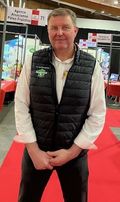
Boris Gondouin, EMB Executive Committee Member from France in charge of Fair Milk
D’fair Mëllech in Luxembourg: safeguarding fair prices for dairy farmers and consumers
-
- © D’fair Mëllech
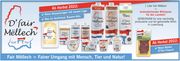
Forty-eight dairy farmers in Luxembourg came together in 2011 to found Fairkoperativ (FKL) and to create their own brand called D’fair Mëllech. The regular (inadequate) milk price is topped up to reach a fair milk price that would allow dairy farmers to make a decent living.
When it comes to producing high-quality, fair milk, the D’fair Mëllech producers uphold high environmental standards on their farms. This means:
- Keeping the use of fossil fuels to a minimum by mainly using feed grown on our land and minimising the import of feed from remote locations. The aim is to produce as much milk as possible using feed produced on the farm.
- We avoid unnecessary soil, water and air pollution. When it comes to the use of fertiliser, we apply nutrients in the quantities that are actually consumed by the crops. Pesticides are only used when economic losses would occur otherwise.
- Soil productivity also needs to be preserved for future generations. We try to maintain pastures and grow a range of feed crops to maintain the diversity of our landscapes and promote biodiversity as well.
- We produce milk while maintaining optimum conditions for animal welfare.
Only then will it be possible to reconcile ecological concerns with environmental, economic and efficient processes on our farms that will be viable in the long term.
Today, our FKL cooperative markets thirteen different milk products in the long-life and fresh milk, chocolate milk, butter, cream, ice-cream, cheese and yoghurt categories. The chocolate milk as well as some ice-cream flavours are produced in cooperation with Fairtrade, i.e. only Fairtrade ingredients are used.
Retailers also support D’fair Mëllech. The direct contact between producers and consumers is the most important feature of our project.That is why our members regularly showcase our products in stores and at many events.
The current economic situation is very difficult and all prices are on the rise. Many people are worried because of the uncertainty about the future. The situation on the dairy market has also changed significantly in recent months. While we were dealing with a substantial cost coverage shortfall of at least 10 cents a few years ago, milk prices have now improved. In spite of rising production costs, dairies have been able to pay a higher milk price. As a result, we are now much closer to the cost-covering milk price demanded by us producers. That is why the dairy farmers at FLK have decided to reduce their “margin” – essentially their profit – on the sale of fair products and to pass on the difference to consumers. This means that consumers can enjoy a price that is “not too high”. In the current situation, ‘fair’ for us fair dairy farmers means suitable consumer prices.
Danielle Warmerdam-Frantz, President, D’fair Mëllech
Background information: Why did you create D’Fair Mëllech?
Danielle Warmerdam-Frantz, President of the Fair Milk cooperative D’Fair Mëllech, explains:
2009 was the year of miserable milk prices! Dairy farmers could think of no other way than to take to the streets and to pour away their milk in the fields. This action born out of desperation and carried out across Europe was widely covered by the media. Consumers were shaken by these events and many asked what they should buy in order to directly support milk producers. That is why we dairy farmers – members of the European Milk Board (EMB) – came together to work on a project that would return the power to make decisions about our milk back to us. We did not want to leave this to policy-makers. We had to take our fate into our own hands. In Luxembourg, some dairy farmers came together and tried to create their own brand.
How many members are currently part of the D’Fair Mëllech cooperative?
Today, we have 57 members. This represents 15% of the country’s farmers specialised in milk production. In the Grand Duchy, we have almost 600 farms, which means that there is still significant scope for the cooperative to grow. We could have more members but the time aspect is the main sticking point for many farmers. The way our project is designed, we ask members to devote at least twelve hours per year to promotional activities for our products. This means they have to go to points of sale and talk about the value of their work. It is one more way of establishing a direct relationship with consumers. Many farmers don’t have the time for this, or it's not something they feel comfortable doing. Of course, everyone is welcome to join!
Please explain to us how the cooperative works.
Farmers produce their milk and sell it to Luxlait (the only dairy in the Grand Duchy but there are three other options in Germany and France). The cooperative then buys the packaged milk and resells it to different points of sale. Consumers buy the milk; the shop makes a profit. We then receive a percentage on these sales. The profits earned are then paid to farmers, distributed equally. Whether you have 20 or 500 cows, the amount you receive will be similar. This is because we believe in solidarity among farmers. Everyone should enjoy decent work and a dignified life. The rules are accepted by all members, and there is no jealously between small and large dairy farms.
Is the generational renewal in place?
Let us make a decent living and the generational renewal shouldn’t be too difficult in the future (laughs). We are seeing young people returning to the sector. Of course, this remains a vocation, a family legacy and always a point of pride. You don’t become a farmer from one day to the next. You have to enter this profession because you love it, it is your passion, and you have to give it your all. It can sometimes be difficult and uncertain, for sure. If you are not up to this challenge, it’s probably better to choose something else. The greatest threat is being unable to take control of events as they occur. If new crises emerge, they could lead to instability on the market and things could become difficult, from one day to the next. We are never totally safe from a situation similar to what happened around 2009, even if it currently seems like there are no clouds on the horizon.
Laurent Trotta, extract from an article published in Roude Léiw on 26 October 2022
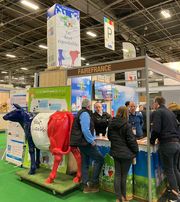
FaireFrance’s farmers participated in SIA 2023, the trade fair for all tastes!
-
- © Maxime Lefebvre
Since 2013, the FaireFrance brand has been selling milk products at a fair price that permits producers to live off their work. A global movement that makes it possible to preserve family farms, the landscape and local know-how. A brand that celebrates its ten-year anniversary this year, with the approval of French consumers that translates into strong sales growth.
Read more...2023, the year of customer canvassing for Faireswiss
-
- © Faireswiss
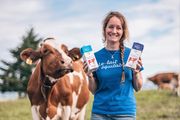
In Switzerland, the Faireswiss range of products finds it difficult to make its way into mass retail. That is why the cooperative has decided to reduce its communication budget and to concentrate on customer canvassing. To this aim, the Faireswiss board has decided to employ someone part-time to canvas food stores, restaurants and other facilities that prepare a large number of meals like residences for persons with disabilities, schools, hospitals etc.
Read more...Die faire Milch in Germany: after a three-year break, we were finally back at the International Green Week in Berlin
-
- © Andrea Münnekehoff, Die faire Milch
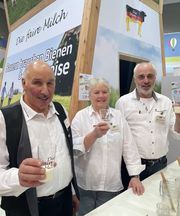
The figures speak for themselves: 1,400 exhibitors from 60 countries and about 300,000 visitors – that was the International Green Week 2023 in Berlin. Die faire Milch was also back with a stand in the North Rhine-Westphalia Hall. The network held together through the Covid-19 pandemic and kept in touch regularly. That is why we were looking forward to seeing each other and it was a joy to finally be back together in Berlin.
Five-year anniversary of Di Fair Milk Säuliamt in Switzerland
-
- © Di Fair Milch Säuliamt
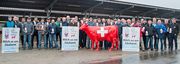
The anniversary of the Di Fair Milch Säuliamt regional project was an occasion for many media outlets to report on it. Everyone was impressed by our performance figures. “Why does this project not exist for Switzerland as a whole?”, that is a question that came up again and again.
Read more...Fairebel - the Belgian fair milk in pictures
-
- © Fairebel
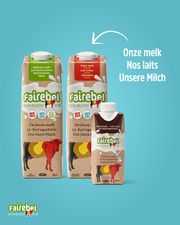
Come join us on a picture journey with Fairebel and meet the people – farmers, Fairebel supporters and consumers – who make fair milk possible in Belgium.
See more....Fair Milk on social media
-
- © EMB
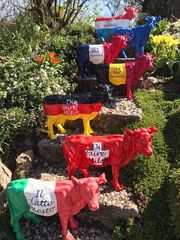
The "Fair Milk" projects are very active on social media, too. Would you like to know more? Here are just some highlights from our Fair Milk countries:
Read more...Legal notice
European Milk Board asbl
Rue de la Loi 155
B-1040 Bruxelles
Tel: +32 2808 1935
Fax: +32 2808 8265
E-Mail: office@europeanmilkboard.org
Website: http://www.europeanmilkboard.org