
Newsletter as PDF
Contact
EMB - European Milk Board asbl
Rue de la Loi 155
B-1040 Bruxelles
Tel.: +32 - 2808 - 1935
Fax: +32 - 2808 - 8265
Dear dairy farmers, dear interested parties,

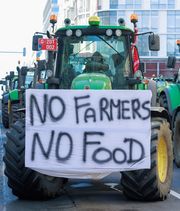
Farmers all across Europe are taking to the streets – for good reason. Tens of thousands of farmers have had enough and are letting policy-makers know about it, not with words alone, but by blocking roads in many places from Lithuania and Germany through France, Belgium and the Netherlands all the way to Italy. Enough is enough.
Farmers come by tractor to call out the continuously widening gap between the retail prices and farm-gates prices – and there seems to be only one way to make politicians listen.
We farmers do not need subsidies – what we need are cost-covering prices along with market reforms to restore market balance and guarantee an adequate income for farmers.
In our view, it is very concerning that the traditional farmers’ representatives, the grand old famers’ unions, who really should be addressing farmers’ dire economic situation, can instead be heard calling for subsidies and speaking up against an adequate voluntary reduction of production, be it for dairy products or crops.
It seems like those organizations are putting forward the arguments of processors and retailers instead of ensuring that farmers are paid a cost-covering price. Rather than securing the farmers’ livelihood – which they should be doing – they are championing an ever-growing export market. Yet, the goal should be to secure stable prices on the market so that farmers are able to meet environmental requirements. Dairy farming must be profitable to ensure the next generations can make a living in this sector.
The old saying that goes “There’s a lot of money to be made in dairy farming – as long as you’re not a farmer” needs to be reworded. The price setting structure needs to be reorganised to ensure that farmers can finally earn their fair share.
Farmers need to reclaim their primary position in the value chain; they must advance from price-takers to price-makers.
Kjartan Poulsen, President of the European Milk Board (EMB)
Open letter from the European Milk Board to the European Commission
-

- © European Union: Christophe Licoppe
President of the European Commission,
Commissioner for Agriculture and Rural Development,
We are addressing this open letter to you because, on the one hand, the situation for European farmers and food production and, on the other, for the EU as a whole has deteriorated dramatically. Not a day goes by without numerous, large-scale protests and actions by farmers all across Europe. The support among citizens for the important concerns voiced by us farmers is growing, while at the same time the faith in political and public institutions is waning.
Fundamental market reforms for cost-covering prices - taxpayers' money/subsidies cannot save agriculture!
-
- © European Union: Christophe Licoppe
As the European Milk Board reported at an international press conference in Brussels on 24 January, subsidies are not going to stop the farmer protests that are taking place in numerous countries. “For those, like us, who have been following the developments in the agricultural sector over the last few years and decades, it is clear that the protests being organised now have not simply cropped up but are driven by very specific causes”, says EMB President Kjartan Poulsen. “These deep-rooted causes cannot be addressed with minor, cosmetic fixes or, worse yet, ignorance.”
It is precisely this disregard for the situation of producers over so many years that has pushed the agricultural system into severe imbalance, where producers are constantly under increasing pressure. “This pressure can only be relieved through fundamental, lasting reforms to the agricultural system”, continues Poulsen.
Far-reaching reforms for a languishing sector
The calls to protest show that the pressure is rising, instead of abating. For example, French farmers announced a national day of action on 25 January 2024 to demand the much-needed improvements from policy-makers. For Véronique Le Floc’h, President of the French organisation Coordination Rurale (CR), signals sent to policy-makers are unmistakable: “The current protests in Germany, France and elsewhere show that a Europe with such poor prospects in the agricultural sector is being rejected. Carrying on with an ultraliberal policy, in which free trade agreements and food imports that do not meet our standards are proliferating, poses a real threat to farmers.”
Protests are also continuing in Lithuania. After setting warning fires in fields throughout the country at the beginning of January, several hundred farmers are heading to the Lithuanian capital Vilnius with their tractors. They demand, among other things, effective solutions to the current milk crisis from political representatives.
Italian farmers have also planned important protest actions. On 30 January, a national mobilisation will take place throughout Italy. Italian producers want to reach, among others, a reform of the Green Deal as well as an end of dumping practices on foodstuffs.
Over recent weeks and months, it has become clear to many that policy-makers, in particular, must react and can no longer shy away from their responsibility and from confronting reality and excessively powerful market players. “We need far-reaching reforms that would finally end the current extremely unequal distribution across the value chain to the detriment of producers”, explains the EMB President.
This means that cost-covering producer prices must be achieved on the market through:
- The active implementation of crisis instruments from the Common Market Organisation like the voluntary production reduction as well as the further development of the instrument in the direction of automatic activation in the case of imminent crises. The Market Responsibility Programme charts the way forward for such further development of the voluntary production reduction.
- Specific EU contract clauses on, inter alia, volumes and cost-covering prices prior to milk deliveries. This must apply for all market players, including cooperatives.
- An EU-wide legislation that makes cost-covering prices obligatory.
- Strict mirror clauses for imports and reliable compliance monitoring.
- Measures to intensify producer pooling to effectively reduce the power imbalance on the market.
Such a market framework is also necessary within the context of the Green Deal, to ensure stable prices on the market and to allow farmers to meet environmental requirements. Dairy farming must be profitable, so that the next generation can also enter the sector. “In addition to the legislative framework, it is also important to support producer projects like Fair Milk”, underlines Poulsen.
There is no way to sidestep these market reforms – the European Milk Board is absolutely certain of this. It must be in the interest of the EU at many levels to take these protests and the problems faced by farmers earnestly. In addition to respect for farmers and their essential work, it is also about food security for EU citizens and, at the end of the day, faith in democratic institutions. This faith weakens even further when such important, socially relevant topics are not taken seriously. Against the backdrop of the upcoming European elections as well, it is important to take effective action now and to create real prospects for farmers through far-reaching market reforms.
EMB press release of 24 January 2024
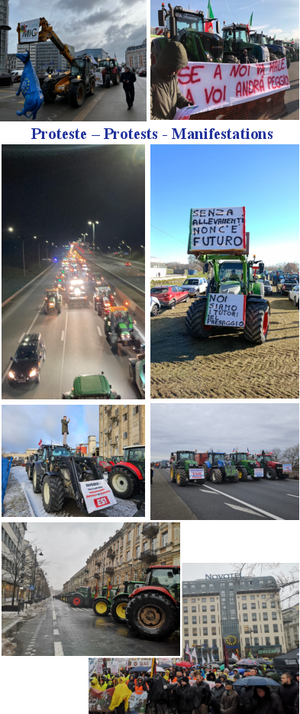
Italian dairy farmers on nationwide demonstration for agricultural reform
-
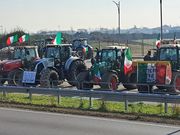
- © APLP
Led by an autonomous and apolitical movement, Italian dairy farmers rallied with their tractors for a nationwide demonstration on 30 January 2024. This unprecedented event ignites a movement for a "Revival of Italian agriculture", that calls for respect and recognition of the farming community's contribution.
Agricultural dialogue in Berlin: a new direction for agriculture
-
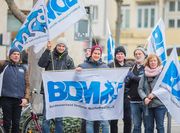
- © BDM
In a mass closing even in front of Brandenburg Gate in Berlin on Monday, 29 January, the agricultural sector, supported by artisans and transport companies, shone a light on the manifold problems they are facing. The far-reaching criticism by farmers did not fall on deaf ears.
Read more...Pragmatic and constructive: European Milk Board calls for urgent reforms in the agricultural sector
-

- © EMB
This year, the European Milk Board (EMB) is also present at the Green Week and is providing information about developments in the dairy sector, together with colleagues from the German dairy farmers’ association BDM and Fair Milk.
Read more...Ireland says: Goodbye 2023. The sooner we forget you, the better it will be!
-
- © ICMSA
As the first months of 2024 come to an end, the prospects and anticipation for Irish dairy farmers could not be more different to those that prevailed almost a decade ago when the European quota regime was about to be lifted. The sense of confidence that was felt by the Irish dairy sector has evaporated.
Read more...Reduction in reference milk price and controversial agriculture budget in Switzerland
-
- © Uniterre
On 20 November, the Swiss dairy sector organisation (IP Lait) announced that as of 1 January 2024, the reference price of A-segment milk would drop by 2 centimes. The reference price will thus go from 81 to 79 centimes per kg. The main reasoning: “The price decrease is mainly due to the significant reduction in milk prices in Europe.”
The drop in the reference price for A-segment milk* is a disgraceful decision! How is it possible that this country mocks its milk producers so blatantly?
Swiss dairy market in crisis: problems due to free trade of cheese with EU
-
- © Pixabay: cocoparisienne
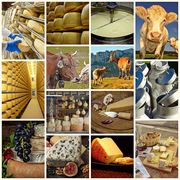
The Swiss dairy market is at risk of going off the rails. The free trade of cheese with the EU since 2007 is the cause of severe problems in Switzerland. The steadily rising exchange rate for the Swiss franc is exacerbating the situation: while the euro was worth 1.50 francs when it was introduced, today it has dropped to merely 0.95 francs. In parallel, production costs in Switzerland are constantly rising, and the milk price is unable to cover these costs.
Read more....Last-minute scramble to get Mercosur done nixes EU credibility on global warming
-

- © ICMSA
The President of the Irish Creamery and Milk Suppliers’ Association (ICMSA), Denis Drennan, has reacted to media reports of a last-minute scramble on the part of the outgoing EU Commission to conclude a Mercosur agreement by warning that any such deal will “end forever” the right of the EU to comment or develop policy in relation to global warming.
Read more...The situation in Sweden
-

- © Pixabay: Paul Moore
Sweden is seeing significant developments, particularly in the dairy sector, which is currently facing major challenges. Amidst the broader geopolitical focus on Sweden's NATO accession and agreements with the USA for access to our military bases, the agricultural sector, and more specifically dairy farming, is experiencing profound upheaval.
Read more...Let’s join forces to call for fair remuneration for sustainable agriculture!
-
- © MIG
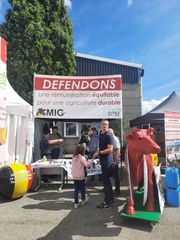
The Belgian MIG (Milcherzeuger-Interessengemeinschaft) recently carried out a survey among its members in order to find collective solutions in light of the constant decline in milk prices. This exercise drew very active and committed participation. The average age of respondents was 47 years and average milk production was 530,000 litres per year on organic farms and 655,000 litres per year on conventional farms. The aim of the survey was to tap into members’ opinion about the collective strategies to be adopted and to determine the price threshold as of which MIG should intervene.
Portugal: Valuing milk in 2024!
-
- © APROLEP
At a recent General Assembly, APROLEP's member dairy farmers voiced their concerns against the backdrop of political and economic uncertainty. They highlighted persistent high production costs, especially for animal feed.
Read more...Legal notice
European Milk Board asbl
Rue de la Loi 155
B-1040 Bruxelles
Tel: +32 2808 1935
Fax: +32 2808 8265
E-Mail: office@europeanmilkboard.org
Website: http://www.europeanmilkboard.org