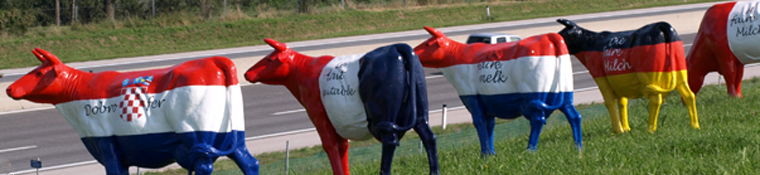


(Brussels, 07.09.2015) They have come to Brussels from all over Europe today with their tractors to unite outside the EU Council building and loudly call on the Ministers of Agriculture to take action in the crisis. The several thousands of dairy farmers are demanding not subsidies, but instead the application of a crisis instrument that reduces the milk volume in times of crisis. “The EU milk market is flooded, prices are plummeting. In some countries they are approaching 20 cents. Unless production is reduced, the market will carry on deteriorating at a pace”, says the President of the European Milk Board (EMB), Romuald Schaber, stressing the necessity for a cut in production throughout the EU. The <link en special-content market-responsibility-programme.html>Market Responsibility Programme (MRP) could be applied: it includes bonus payments for farmers who voluntarily cut production.
His fellow farmers from countries like France, the Netherlands, Belgium, Denmark, Italy and Spain are demanding today in Brussels that the EU Ministers of Agriculture take joint appropriate action quickly. National approaches cannot stabilise the situation. This is also evident from the protests that have been going on for many months in the individual European states. For instance, neither the assurance of an unrealistic guaranteed minimum price in France nor the promise of 300 euros a cow in Spain can ease the situation in those countries. “The politicians have been hell-bent on a massive export drive with an increase in volumes throughout the EU. That has failed miserably, and now has to be rectified on the EU level as well. Individual nations cannot hope to come up with any lasting solutions on their own”, Schaber says. According to Schaber, EU Commissioner for Agriculture Phil Hogan and the German Minister of Agriculture Christian Schmidt in particular have to abandon their awkward attitude. Because the measures that have been used since last year, such as private storage, have not achieved any stabilising effect in the face of a globally flooded milk market.
Other groups of society are becoming increasingly verbal in their criticism of the current liberal market export policy. For example, many consumers and veterinarian organisations are calling for caps on production to ensure animal welfare and ecological sustainability.
If the Council of the Ministers for Agriculture fails to take any effective measures today, and instead comes up with just makeshift solutions, the protests will be stepped up in every country and across the EU. Schaber: “For the dairy farmers it is all about the survival of their farms; for consumers it is all about regional, healthy food production throughout the EU; and for the EU it is all about a stable, competitive dairy sector. If the politicians refuse to reduce the EU volume, it is the duty of us all to take to the streets and force political changes. There is simply too much at stake.”
Follow today’s demonstration on our Facebook page with pictures and more info!
The European dairy farmers’ demands:
- Cost-covering milk prices and a crisis instrument, the Market Responsibility Programme (MRP), NOW!
- The money from the super-levy must be used immediately to finance a voluntary restraint on milk supply in order to reduce the volume!
Effective measures in the dairy sector |
| The wrong measures for the sector |
The excessive volume of milk must be reduced in times of crisis using the Market Responsibility Programme (MRP). It can stabilise prices gently, for instance with a voluntary restraint on supply (cutting production in return for a bonus payment). |
|
What is wrong is a purblind export strategy and flooding other markets with EU surpluses. Those markets are just as saturated (Russian ban on imports, China’s decrease in imports). This will only put further downward pressure on the price for everyone. |
Raising the intervention price only whilst simultaneously reducing the volume. This results in only a brief intervention period, as a stabilised market price kicks in soon. |
|
Raising the intervention price without simultaneously reducing the volume is problematic. It only further boosts production. |
A proper analysis of the situation is required. The Russian embargo and the decrease in exports to China have to be put in the right context: they are reasons why demand cannot keep up with the growth in production. That is why the growth in production has to be curbed.
The same applies to other geopolitical or geo-economic developments brought on by crises. For instance, if the trend in oil prices, financial market crises or terrorism cause demand to fall, there has to be a reaction on the supply side as well.
|
| Futures markets are not suitable for preventing crisis prices. For, even if low prices are also to be expected in the months to come because of a chronic oversupply, futures will not be concluded with reasonably high prices. Because prices are also determined by the milk market/its expected development.
Subsidies are not a solution. Direct payments to the producers cannot either make up for the loss or eliminate the cause of the problem. That is because the EU market is facing chronic surpluses which cannot be eliminated by simple subsidy payments.
|
Contacts:
EMB President Romuald Schaber (DE): + 49 (0)160 352 4703
EMB Press Officer Regina Reiterer (DE, EN, FR): +32 (0)2 808 1935