

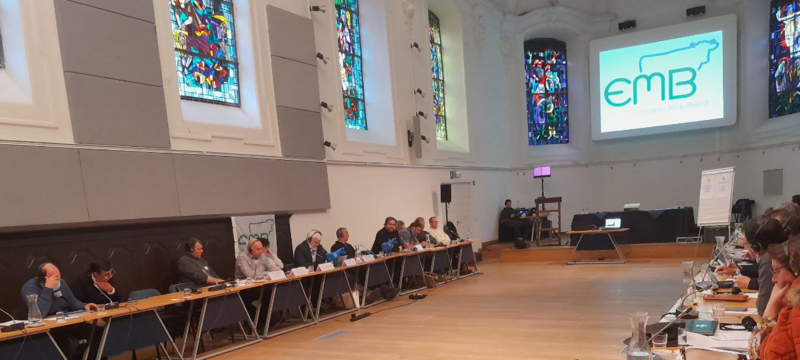
(Brussels, 18 November 2021) Representatives from twelve European countries gathered this week at the European Milk Board’s (EMB) General Assembly in the Belgian town of Leuven to jointly discuss key solutions for the dairy sector. This is because the mistakes made in the EU agricultural sector with all their problematical consequences are increasingly obvious. For instance, milk production is already declining in important production countries, as long-standing cost shortfalls have been driving dairy farmers out of production in droves for years now. Against this backdrop, the European milk producers’ representatives are reaffirming the need for a change in strategy to guarantee a future for the sector, the farmers and the reliable production of food for the citizens of the EU.
The existing cost pressure, which is a burden on producers owing to the current liberal export and import strategy, is compounded by the pressure on income created by the current and future environmental strategies such as the Green Deal and “Farm to Fork”. As the numerous milk producer representatives attending the meeting stressed, environmental and climate measures are required for all society’s sectors. But they have to be thought through to the end. In the agricultural sector, for instance, the current strategies must be designed in such a way that they are manageable for the dairy farmers and really effective for the environment and climate.
The unanimous opinion of the General Assembly was that it was imperative for the solutions for the sector to create general framework conditions that guarantee a cost-covering producer price in order to correct past mistakes and prevent new mistakes in a green policy. The dairy farmer representatives attending highlighted the need for instruments that can temporarily limit production in times of crisis, and for a policy that focuses on the solid financing of sustainability measures. For the farming sector that must mean that all production costs – including the costs of sustainability – are covered and not shifted on to the producers.
Sieta van Keimpema: “The CAP reform adopted this year makes the voluntary volume reduction an official instrument for times of crisis in the EU’s Common Market Organisation. This is a first small step on a long way the political decision-makers still have to go along with the farmers to radically reform the current agricultural system.” The EU sustainability strategies also had to be adapted on the way. “We want a climate policy – also, of course, because we farmers are the first to feel the impact of climate change. But it must be affordable and really effective for the environment and climate.”
Contacts:
EMB president Sieta van Keimpema (EN, NL, DE) : +31 (0)612 168 000
EMB vice-president Kjartan Poulsen (EN, DK, DE): +45 (0)212 888 99
EMB director Silvia Däberitz (EN, DE, FR): +32 (0)2 808 1936
EMB press office Vanessa Langer (EN, DE, FR): +32 (0)484 53 35 12