

Brussels, 04.07.2016: Denmark and the Netherlands are often touted as countries with robust production and large farm structures. In this context, it is said that large, so-called effective farms perform very well in free competition. Large production volumes allow them to cover costs and that they can also successfully hold their own in the face of competitors outside of Europe.
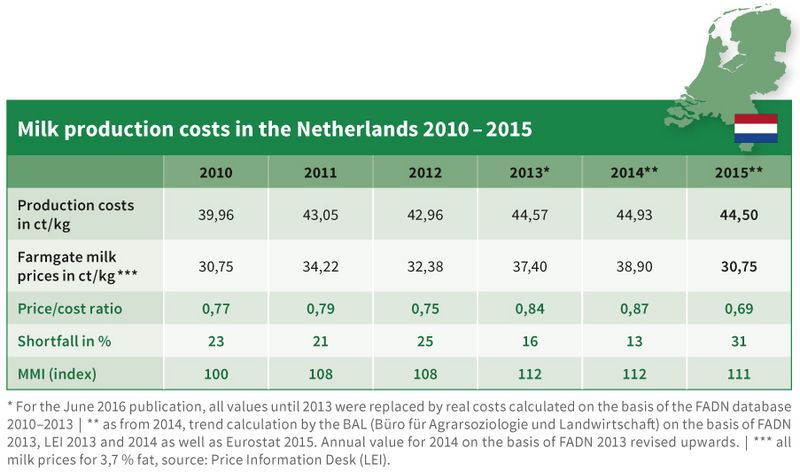
However, recent figures on production costs and milk prices in both countries have proved that this line of argumentation is simply absurd. With a shortfall in production cost coverage of 26 and 30 percent respectively, the current European trend of high losses in production is apparent in Denmark and the Netherlands as well.
As shown in recent studies by the Büro für Agrarsoziologie (BAL), the deficit in the Netherlands between the average price of 30.75 cents and costs of 44.50 cents/kilogramme of milk is almost 14 cents for the year 2015. With costs of 41.70 cents and an average price of 31.03 cents/kilogramme of milk, losses in Denmark are more than 10 cents.
Falling prices in 2016 have made the situation even worse and this calls for a solution that would address the rising overproduction in the EU.
Voluntary production cuts - a smart instrument for stabilisation
Voluntary production cuts would be a good instrument to rein in volume distortions. Farmers would receive financial compensation for such voluntary reductions in production volume - thus no one comes out a loser, and this measure would be readily accepted by European milk producers. This would also be a good alternative for big and smaller producing countries that are concerned about being forced to reduce production. If the financial compensation is high enough, voluntary reductions could scale back volume sufficiently to stabilise both the market and milk prices - something that would come as a great relief for all milk producers in the European Union battling the current circumstances.
The idea is to prevent losses before they occur - to make sure that damaging volumes of milk are not produced in the first place. This would reduce dependence on ineffective instruments like intervention and private storage, which have had very little effect in the current crisis.
Be it in the Netherlands and Denmark with larger farms or in Member States with smaller or mixed structures - milk production is a key economic player all across Europe. This means that the European Commission and the national governments bear a great responsibility in terms of EU agricultural policy: Milk production must be comprehensively maintained, thus securing jobs within and beyond the dairy sector and offering EU citizens a regional and varied diet. When will those responsible finally take their duties seriously?
Detailed figures from the study can be found in the attached MILK PRODUCTION COSTS data sheets for Denmark and the Netherlands respectively.
The cost calculation studies for the Netherlands and Denmark were entrusted by the EMB together with the respective member organisations - the Dutch Dairymen Board and LDM Denmark - to the Büro für Agrarsoziologie.
Contacts:
EMB President Romuald Schaber (DE): +49 (0)160 352 4703
EMB Manager Silvia Däberitz (DE, EN, FR): +32 (0) 2 808 1936