

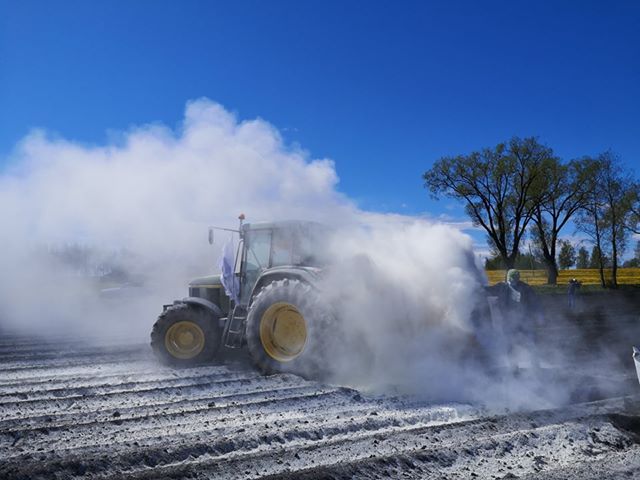
“We dairy farmers say YES to an EU-wide milk volume reduction scheme and NO to private storage aid for butter, milk powder and cheese as a crisis measure.” While dairy farmers across Europe turn to the Commission and the EU Member States with this appeal, a thick fog of skimmed milk powder spreads over fields in numerous French departments. At the same time, a huge stack of milk powder reaches up to the sky in the German capital in front of the Federal Chancellery, and dairy farmers in Italy, Denmark, Lithuania, Luxembourg and Belgium use milk powder campaign events to strongly demand appropriate crisis measures for the dairy sector.
According to Erwin Schöpges, Belgian dairy farmer and President of the European Milk Board (EMB), the many milk demonstrations send an important signal to policy-makers: “Skimmed milk powder has now become the EU-wide symbol for the misguided crisis measures implemented by the European Union in the dairy sector. These measures must take a different direction if they are to have any real effect in counteracting the crisis,” says Schöpges.
The Coronavirus crisis has caused the demand for milk products to collapse. As EMB Executive Committee member Roberto Cavaliere reports from Italy, the shut-down of schools, kindergartens and public institutions, coupled with the almost complete standstill in the hospitality and catering sector, has led to a drastic reduction in the purchase of milk products. “We are currently producing way too much milk and this volume needs to be reduced EU-wide. We dairy farmers are ready to take on our share of the responsibility and participate in a volume reduction programme coordinated by the European Commission,” says Cavaliere. However, this is not what the EU is proposing. His colleague Boris Gondouin, who is a dairy farmer in France and an EMB Executive Committee member as well, is rightfully upset – like so many European dairy farmers – that the European Commission has decided to back subsidies for private storage. “These subsidies do absolutely nothing to change the difficult reality faced by dairy farmers during the Coronavirus crisis. Especially milk prices for producers are falling. However, 30 million euros – as announced provisionally – are spent on subsidies for processed milk products and will go to the private industry. This means that the current EU measure was taken for the processing industry, not for the farmers.“ Johannes Pfaller, dairy farmer in Germany and EMB Executive Committee member, adds: “It is totally absurd to waste resources to make products for which there is no demand. Simply for these products to then be put into storage using subsidies.”
In order to manage the milk crisis:
- A crisis measure must directly address milk volume.
- The EU and its dairy farmers must take on shared responsibility. A programme that can be implemented in each and every EU Member State should be launched. Dairy farmers willing to reduce their production volume are then paid compensation through this EU programme for every litre of milk they do not produce*.
- Stacks of butter and mountains of milk powder should not be allowed to pile up in the EU by subsidising the storage of already processed products. Products in storage are still part of the available supply and therefore suppress milk prices. The announced 30 million euros would therefore be better spent on a volume reduction scheme rather than on private storage.
- The EU should be willing to learn from its past mistakes. Private storage aid and the permission for among others producer organisations and interbranch organisations to reduce production regionally (rather than EU-wide) were completely ineffective as crisis instruments in 2015-2017. The EU volume reduction programme, on the other hand, was a success (details in study "Analysis of the EU volume reduction programme 2016/17").
* Detailed information in Market Responsibility Programme
As Danish dairy farmer and EMB Executive Committee member Kjartan Poulsen underlines, this is not the first time that the EU is choosing the wrong crisis-management instrument. “Dairy farmers from the EMB and other associations highlighted the issue of massive stocks building up in storage back in 2017 with a large milk powder demonstration in Brussels. It is therefore our urgent appeal to the EU to stop using the instrument of intervention storage and to start working together with dairy farmers, so that we can implement a volume reduction programme together,” says Poulsen.
Today's Europe-wide policy-related milk powder demonstrations will not be the last of their kind. Many German producers have already announced further demonstrations in the coming days.
Photos and videos of today's milk powder campaigns
Contacts:
EMB president Erwin Schöpges (FR, DE, NL): +32 (0)497 904 547
EMB board member Johannes Pfaller (DE, EN): +49 (0)170 4573679
EMB board member Boris Gondouin (FR): +33 (0)679 620 299
EMB board member Roberto Cavaliere (IT, FR): +39 (0)335 635 6361
EMB board member Kjartan Poulsen (EN, DK, DE): +45 (0)212 888 99
EMB director Silvia Däberitz (EN, DE, FR): +32 (0)2 808 1936
EMB press office Vanessa Langer (EN, DE, FR): +32 (0)2 808 1935