

(Brussels, 18 November 2020) According to the “Ökobarometer 2019” survey on organic food products conducted by the Federal Ministry of Food and Agriculture (BMEL), the demand for organic products from German consumers is constantly growing. Social standards and a fair income for producers are cited as additional reasons driving the decision to buy organic. But are these products really economically and socially-sustainable?
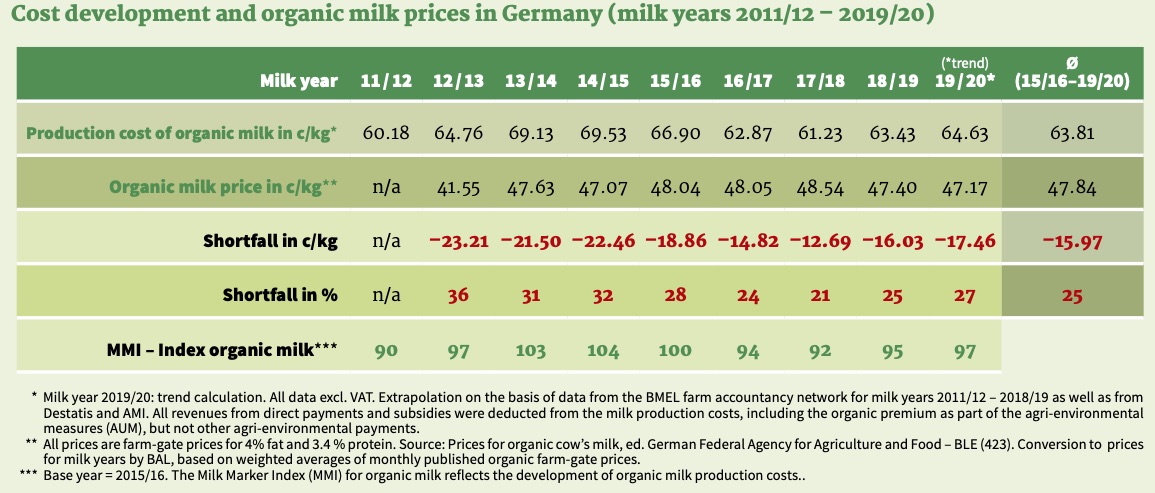
As current calculations show, producers in Germany were paid an average 47.17 cents per kilogramme of organic milk for the marketing year 2019/20. According to these calculations, however, the production costs amount to 64.63 ct/kg, when producers also receive fair remuneration for their work. Thus, producers were facing a cost shortfall of 17.46 ct/kg.
Over the 5 years from 2014/15 to 2018/19, organic dairy farmers spent an average 51.70 cents exclusively on farming inputs and general operating costs without wages. This means that farm managers and their families were left with a mere 8.41 cents per kilogramme of milk in hand as remuneration for their work. This corresponds to an hourly rate of about 7.62 euros and does not even come close to Germany’s standard minimum wage. According to the cost forecast for 2019/20, the hourly wage this year would even be around seven euros per hour. This shows that organic milk cannot really be considered socially and economically sustainable.
The data on milk production costs in the German organic milk sector has been compiled by the German Farm Economics and Rural Studies Office (BAL) and is updated every year.
However, the cost shortfall is not just an issue for producers in Germany, as Kjartan Poulsen, EMB Vice-President and organic dairy farmer in Outrup, Denmark, explains: “Like in the conventional sector, there is an increasing deficit between farm-gate price and production costs for organic milk in many European countries. It will be impossible to achieve the European Commission’s Green Deal objective – 25% organic farming by 2030 – with this ground reality. A significant increase in sustainable organic production in the EU can therefore only remain a pipe dream.”
Cost development and organic milk prices
The Milk Marker Index (MMI) for organic milk charts the evolution of organic milk production costs. For the marketing year 2019/20, the MMI for organic milk was 97, i.e. production costs for German organic milk producers reduced by three percent as compared to the reference year 2015/16 (2015/16 = 100). As compared to the previous year (2018/19), however, they increased by two percent.
Here you see the development of costs, prices and the Milk Marker Index for organic milk over time.
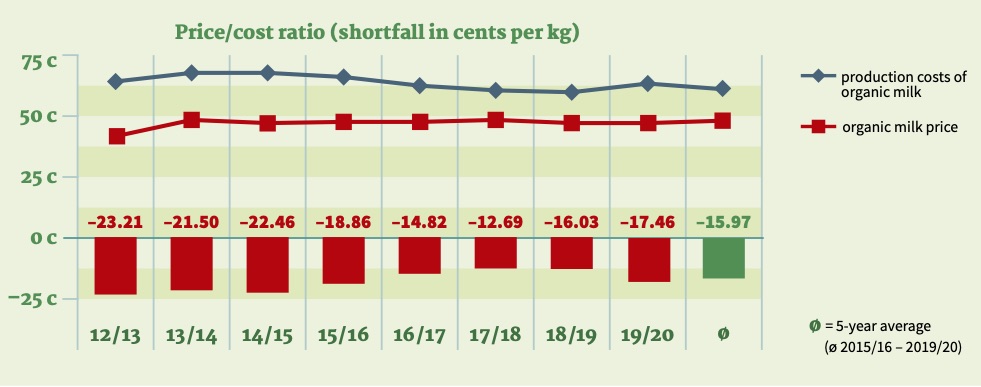
Price/cost ratio (shortfall)
The price/cost ratio shows to what extent producer prices cover milk production costs on organic dairy farms. In the marketing year 2019/20, the milk price only covered 73% of producers’ production costs; there was thus a shortfall of 27% or 17.46 cents per kilogramme of organic milk.
Here you see the cost shortfall since the marketing year 2012/13.
Study on milk production costs in six key milk producing countries
Cost calculations are regularly carried out as an average of all dairy farms and are not limited to organic production. It is very clear that even conventional dairy farmers are not being paid cost-covering prices.
You can find milk production cost calculations for Belgium, Denmark, Germany, France, Luxembourg and the Netherlands for 2017 here.
A chronic shortfall between production costs and milk prices – what is the solution?
In order to counteract this chronic shortfall, the European Milk Board (EMB) calls for a legally-prescribed crisis instrument. The Market Responsibility Programme (MRP) observes and reacts to market signals, for example by temporarily adjusting production volumes in times of crisis.
You can find a short description of the EMB’s Market Responsibility Programme here.
Background:
The European Milk Board (EMB), the German dairy farmers’ association BDM and the German producer organisation MEG Milk Board have commissioned the German Farm Economics and Rural Studies Office (BAL) to carry out a study on production costs for organic milk and to update this study annually. It is an important complement to the Milk Marker Index (MMI), which has been published since 2013, as well as to the EMB’s reports on general milk production costs in different EU Member States.
Download data sheet here
Contact:
EMB Press Officer Vanessa Langer (DE, EN, FR): +32 (0)2 808 1935