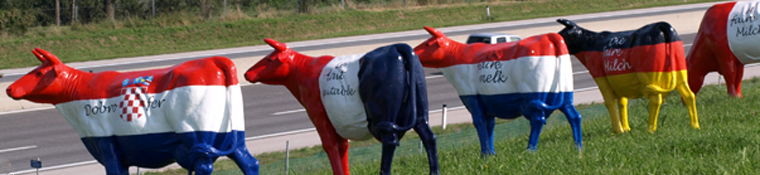


(Brussels, 20 February 2020): For the Lithuanian dairy farmers' association LPGA as well as numerous other organisations from Lithuania, Latvia and Estonia, it is high time for an equal distribution of direct payments to become a part of the Common Agricultural Policy (CAP). At today's protest, which is supported by umbrella organisation European Milk Board (EMB), the Baltic producers are calling on the EU for fair and equal treatment. The European Milk Board also believes that farmers across the EU are being socially and economically left behind, especially due to constant recurring crises. Their request for the implementation of a functioning crisis mechanism is directed not only at heads of state and government gathered today in Brussels, but also at all the EU Institutions, as they are currently working on the CAP reform.
Same requirements but different direct payments
It is slowly coming to light through a number of different studies that the EU milk price does not cover production costs. As long as this cost shortfall continues to prevail, producers remain dependent on subsidies. However, these subsidies vary from one Member State to another, such that in 2017, Baltic farmers received only 54 to 60 per cent of the EU average in direct payments. Jonas Vilionis, President of the Lithuanian dairy farmers' association LPGA, sees this unequal treatment as a major issue: "Direct payments are lower, but all products have to comply with the same requirements. Our farmers must comply with the same environmental-protection, animal-welfare and food-safety standards as in other EU Member States, but without the equivalent compensation." This creates a divide between EU producers. Vilionis therefore calls for an equal distribution of direct payments. This would, however, only be possible with an appropriate CAP budget. Therefore, the EU agricultural budget should not be reduced in any way.
Cost-covering milk prices instead of subsidies
The European Milk Board, the umbrella organisation of European dairy farmers, as well voices its opposition against this two-tier system. It also highlights the need to reduce the dependence of farmers on subsidies to make a living. For Erwin Schöpges, President of the EMB, it is therefore important for agricultural income to be earned from the market in the medium term. "We need milk prices that cover production costs – including fair remuneration for farmers," says Schöpges.
More stable revenues with a crisis instrument in the Common Agricultural Policy
The constantly recurring crises, which lead to major losses for farmers, are a real burden in the dairy sector. The EMB, therefore, believes that a functioning crisis instrument like the Market Responsibility Programme (MRP), which would keep the dairy market in equilibrium and prevent drastic price reductions, is an absolute must within future agricultural legislation.
Sieta van Keimpema, Vice-President of the EMB, calls on the EU Institutions like the Commission, the Council and the Parliament to support the inclusion of an effective crisis instrument in the future Common Agricultural Policy. "Many EU policy-makers have seen the devastating consequences of recent crises with their own eyes. That is why truly important proposals are now on the table and there is a strong motivation among policy-makers for such an instrument. It is essential for the proposals like voluntary volume reduction with capping1 during crises as well as – during severe crises – temporary compulsory reduction2 to actually find their way into the CAP. This would provide the legal basis for quick reactions to market disturbances."
Treating EU farmers unfairly should no longer be business as usual: Baltic farmers should not be left behind as compared to their colleagues in the rest of the EU, just like farmers across the EU should not be left behind as compared to the rest of society. Today's protest is therefore an urgent call for fairness and equal treatment in the EU. The constructive proposals from dairy farmers show, furthermore, that such an approach is absolutely realistic.
Background: Important crisis instruments for the CAP
Addressing the root cause of crises: Addressing overproduction
1 Voluntary volume reduction with capping: If the market is in crisis due to high production volumes, the European Commission can call for a voluntary production reduction. Producers who reduce their production as compared to the same period of the previous year, and thus provide market relief, are paid a compensatory bonus. To ensure that these production cuts are sufficiently effective, all other producers should be subject to capping, i.e. for a certain period of time, no one should increase their production as compared to the same period of the previous year.
2 Temporary compulsory volume reduction: In the case of severe market disturbances where voluntary volume reduction is not enough to reinstate market balance, it should be possible to activate a compulsory volume reduction scheme for all producers. This would mean that all producers would have to reduce their production by 1 to 2 per cent for a certain period of time. This reduction would be lifted after this period and producers would be free to revert back to their usual production volumes.
<link en>Please find here photos of the rally
Contacts:
Eimantas Bicius – Director of the Lithuanian dairy farmers' association LPGA (LT, EN): +370 615 85255
Vanessa Langer – EMB Press Officer (DE, EN, FR): +32 2 808 1935