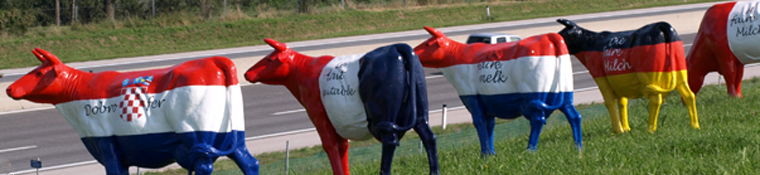


With the planned merger of Arla Foods and the DMK Group and an estimated combined pro forma revenue of 19 billion euros, a new cooperative giant will soon be on the market. EMB President Kjartan Poulsen, himself an Arla member, sees this as yet another step in the move towards ever larger, more diversified structures, which is all too familiar in the sector. As a result, and for long time now, cooperatives have ceased to be the representatives of producers' interests they claim to be on paper: "Cooperatives have a positive ring to them in the public perception: communal, democratic, solidarity structures. They are seen as a counter-model to profit-oriented corporations and as economic support for farmers. But this image needs an urgent update – especially because cooperatives in their current form neither live up to their responsibility nor meet the standards they themselves set out," says Poulsen.
1. What are cooperatives in theory?
At their core, cooperatives are associations of people with common economic interests. Members participate financially, and, at the same time, should be able to participate democratically. The primary goal is to support the economic situation of members, not profit maximisation.
2. What they are not
Cooperatives are not pure service providers or corporations. Their role is not to simply buy raw materials cheaply and process them profitably – they must act in the interest of their members. They are not an end in themselves. But this is exactly where the problem begins.
3. The third category: What cooperatives pretend to be – to evade obligations
Cooperatives like to present themselves as democratic, solidarity actors to evade several legal and political obligations. For example: Obligational contracts between agricultural producers and processors are currently being discussed at EU level – an instrument for creating fair and transparent price structures. Cooperatives regularly demand exceptions to this obligation. Cooperative members are also denied a better position in negotiations as they cannot be represented by producer organisations. Cooperatives present the following reasoning: As a community of producers, there is no need for additional regulations here.
But this does not correspond to reality.
-> Reality: Membership without power
The actual balance of power in many cooperatives is asymmetrical. Individual members have neither the legal or economic knowledge nor the time or structural resources to really shape decision-making processes. Many cooperatives have become very large and diversified over time and are not run by members, but by a management team. Members are often only involved via representative assemblies. Crucial lines of business – such as marketing – are often outsourced, making control even more difficult. The possibility for the member base to exert influence is minimal.
In addition, there is economic dependence: Many farmers are dependent on their cooperative as a buyer – criticism threatens their livelihood. This leads to a systematic weakening of democracy within the cooperative. What remains is a façade of democratic participation – not a lived reality.
-> Contradiction in the business model
A particularly clear conflict of interest is evident in the dairy sector. Cooperative dairies act on the market as processors and sellers. Their interest is therefore in procuring the cheapest possible raw materials – i.e. low milk prices. At the same time, they should be fighting for good producer prices in the interest of their members. These goals are fundamentally contradictory. If cooperatives act as market players, they must also be treated and regulated as such.
Cooperatives cover large market shares – in many places they are the main buyer. The new cooperative giant that Arla and DMK are currently creating is a prime example of this. So, if cooperatives are exempted from contractual obligations, this means that a large part of the market and thus the problem is not covered. Fair prices and transparent contracts remain an illusion – at the expense of producers.
What are cooperatives afraid of?
Why do cooperatives resist clear rules that are supposed to promote fairness and transparency? Perhaps because they would then have to disclose that their role as supposed representatives of members’ interests has long since been undermined. The fear lies in the disclosure of a power imbalance that contradicts the cooperative ideal.
"We have to talk about cooperatives – openly, honestly and without ideological blinkers. They are important players, but not saints. Anyone who behaves like a company must also be treated like one. This is especially true when it comes to fair prices, market transparency and political responsibility," says Kjartan Poulsen.
In concrete terms, this means:
- The obligation to conclude contracts between producers and buyers, which has currently been put on the table by the European Commission, must apply to cooperatives in the same way as to any other processor.
- Cooperative members must have the possibility to be represented by producer organisations in negotiations with processors.
- The size thresholds for these producer organisations must be increased to keep up with market shares of processors. Currently, such organisations are restricted to 4% of the EU market and 33% of national volumes. It should be increased to 30% for the EU and pooling limits should be abolished altogether at national level, to make it possible to negotiate with processors on an equal footing.
* For detailed information on the development of cooperatives, see also: Cooperatives Between Myth and Reality, www.europeanmilkboard.org/fileadmin/Dokumente/Positions_EMB/12-02_Positions/Cooperatives.pdf