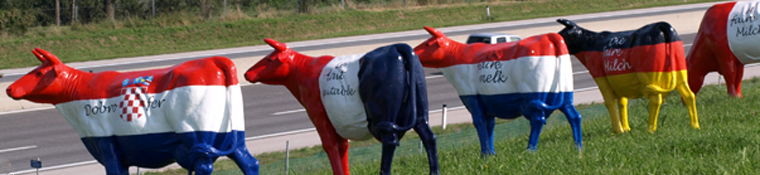
On 4th September 2025, the European Milk Board (EMB) took part in a large-scale protest in Brussels, where numerous organisations from the agricultural, environmental and development sectors jointly expressed their opposition to the planned trade agreement between the EU and the Mercosur countries.
For the EMB, it is clear that the Mercosur agreement unilaterally serves the interests of large trade and industrial groups – with serious consequences for European agriculture, the environment and food security.
“This agreement is an example of a trade policy that systematically disadvantages farms,” says EMB President Kjartan Poulsen. “It fuels cut-throat competition in which high-quality, sustainably produced food from Europe can hardly compete with cheap imports.” The EMB sees a major problem in the planned opening of the European market to agricultural goods from South America, which are often produced under conditions that fall far short of European standards – for example, in terms of environmental and animal protection or food ingredients. For European producers, who are subject to stricter requirements, this means a massive distortion in competition.
Furthermore, the agreement contradicts fundamental goals that the EU has set for itself – for example, regarding climate protection, sustainability and regional supply. Higher import of products transported over long distances increases emissions and undermines efforts to achieve more environmentally friendly food production within Europe.
The EMB also takes a critical view of the agreement from a security policy perspective. A stable, independent food supply within Europe is of central importance – economically, socially and politically. Growing dependence on global markets makes the food system more vulnerable to crises and weakens security of supply.
Furthermore, the EMB notes with concern that EU policymakers appear to be striving to push through the agreement under considerable political pressure and without sufficient democratic scrutiny. Such a far-reaching decision must be made transparently and with the involvement of parliaments and civil society.
The EMB therefore calls for a fundamentally new trade policy: it must create fair conditions for agriculture, take ecological and social responsibility seriously and be based on democratic legitimacy. |