

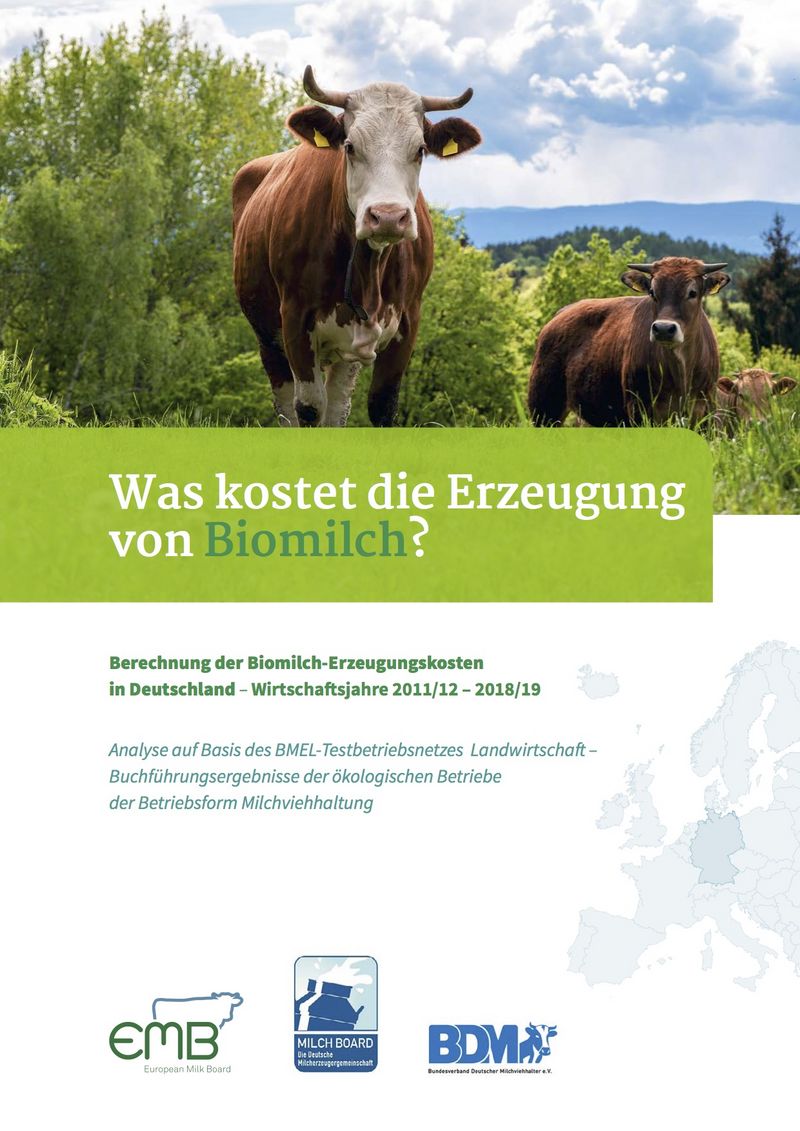
Production costs of 60.29 cents per kilogram of organic milk and an average organic milk price of 47.40 cents: in other words, cost coverage of only 79 percent. These are the findings of the latest study on the cost of producing organic milk in Germany conducted by the Office for Rural Sociology and Agriculture (BAL, Büro für Agrarsoziologie und Landwirtschaft) and commissioned by the European Milk Board (EMB), the German dairy farmers’ association (BDM) and the MEG Milk Board. This study also takes into account a fair income for producers. The figures revealed by this study clearly show that organic milk producers too are selling their products at a loss.
Here are some impressions from Klaus Vetter, an organic farmer from Hesse, who was part of the working group set up as part of the study.
Mr Vetter, what are your takeaways from participating in the working group?
Participating in the study was a very enriching experience. The most exciting aspect was to see how it has a direct link to the reality of running a farm. As a farmer, this is especially important for me. Every organic farmer can use the results as a kind of yardstick for his farm.
Did the result get you thinking?
Most definitely! Even though the results did not really surprise me. These figures should motivate us organic farmers to take action because we are going head-first into the same situation that we wanted to get out of. For the organic sector to be sustainable, our farms must remain economically viable over time. We should not lose sight of the losses recorded on each and every milk statement. These losses were, to a large extent, covered by our families in the form of unpaid work. This has to get you thinking!
As an organic farmer, how will you be able to use this study?
One thing we did not have was concrete figures. Once it came to light in January 2009 that Lidl and Bioland had reached a marketing agreement, it was already clear to me that we organic farmers had to create a counterweight. For this, we need to present a united approach. The basis of such an approach is uniform price demands. Thanks to this study, we now have a solid reference to do just that.
So, what’s the next step?
As I see it, we have one more task as organic farmers: pooling organic milk in an organic milk producers’ organisation. This producer organisation should operate across Germany – or better yet, across Europe – and should be the interlocutor upstream of the dairies. It should set prices and, if necessary, regulate volumes in order to avoid overproduction. Thanks to this study, we can now state what a fair price would be – our production costs. Now all that's left to do is to convince our colleagues that we need a strong producer organisation – as I see it, there is no way around it. Let's make it happen!
Mr Vetter, thank you for speaking with us.
You can find further information about the cost of organic milk production in Germany in this brochure in German (English version available soon).
This article is part of our current newsletter. More interesting articles here.