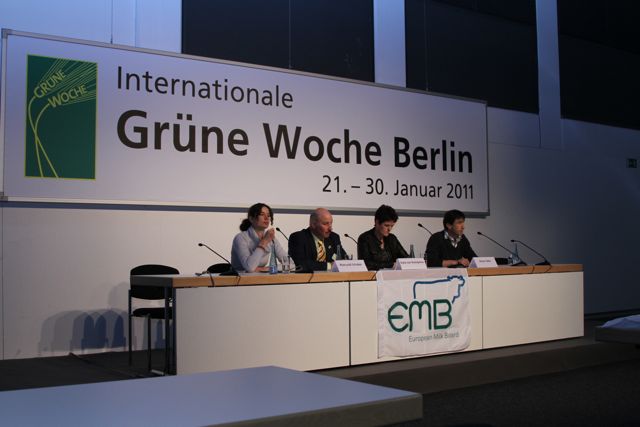


The analysis of the latest proposals of the EU Commission concerning the milk sector is very critical. The European Council and the Parliament should work together to improve the proposals of the Commission considerably. Contracts and interbranch organisations are the wrong approach. The Commission’s view on the position of cooperatives is incorrect. Bundling of milk producers is not consistent enough. The voluntary waiver of delivery is the only positive approach – a European monitoring agency has to be implemented.
Berlin, 21.01.2011: Romuald Schaber, the president of the European Milk Board (EMB), says very clearly at the Green Week in Berlin that the current approach of EU policy-makers cannot stabilise the dairy market. „The proposals presented by the European Commission are neither one thing nor another. Admittedly, the proposals are only a blueprint. We have to cooperate with the European Council and the European Parliament to improve these proposals considerably.”
Romuald Schaber adds: „What lies at the heart of the problem of the dairy sector? The volume on the market is too big, so that the producers are in weak position vis-à-vis the processing industry and the retail sector.” European policy-makers are on the wrong track if they are of the opinion that this problem can be solved by interbranch organisations or contracts. Anton Sidler, board member of the EMB and representative of the French milk producer organisation Association des producteurs de lait indépendant (APLI) explains: „By proposing facultative contracts the Commission does not strengthen producers. A situation where numerous disorganised suppliers, i.e. the producers, have to face up to highly concentrated dairies renders negotiations on an equal footing impossible.“ His colleague and fellow board member Willem Smeenk of the Organisation des producteurs de lait (OPL) adds: „Due to the unequal positions the producers who are the weakest market participants have to accept the terms and conditions of these contracts dictated by the processing industry.”
According to Sieta van Keimpema, vice-president of the EMB, the European Commission’s view on cooperatives is problematic as well. „The assumption prevails that cooperatives would per se take into account the interests of milk producers and that many measures should not apply to them. However, cooperatives actually consider the interests of milk producers only to a certain extent.” The fact that producers own the production means of each cooperative should exclude, at least in theory, the existing problem of producer prices. The real structures are, however, different. Sieta van Keimpema says furthermore: “In many cases the cooperatives no longer own their production means. The production means are outsourced to companies. There are also numerous examples where up to 50% of the members of a cooperative are no active milk producers. The interest in a fair producer price is logically not compatible with the interest in cheap resources and thus lower producer prices”. To deprive members of cooperatives of their right to bundle themselves for negotiations would therefore be fatal.
Elements of an effective reform
An effective policy is based on two elements: an appropriate degree of bundling of milk producers and a milk volume control managed by milk producers themselves. Therefore a European monitoring agency that determines, based on the full production costs, a price range that serves as a benchmark for volume adjustments has to be created.
Romuald Schaber thinks that the current EU policy does not yet match this strategy: “With its proposal concerning the bundling of producers the Commission has indeed set in motion a vital element. The proposed maximum degree of bundling of 3,5% Europe-wide and 33% at the national level cannot to strengthen the position of milk producers adequately. Parliament and Council have to insist on a degree of bundling of 30% Europe-wide and on the creation of the monitoring agency mentioned above. This monitoring agency can provide the framework for a reconciliation of interests of milk producers and milk industry and ensure that interests of society are taken into account.
The EMB sees, however, positive aspects of the policy of the European Commission as well. The European Commission recognises, for instance, in its report on the dairy market that was published in December a voluntary waiver of delivery as possible instrument to avoid surpluses. This is an important approach. In contrast to the increase of quotas, export subsidies and intervention buying implemented by EU policy-makers so far, a voluntary waiver of delivery would not at first flood the market with milk and later require an expensive disposal of the produced volume. This proposal is a sign that the European Commission is reviewing its current policy – even though these deliberations do not yet suffice. The Commission should pursue this approach of preventing overproduction. The flexible adaption of the supply to the demand is essential for a stable market.
Contact:
EMB press office: Silvia Däberitz (DE, EN, ES): 0049 2381 4361 200
Please click here for a pdf-file of the press release
Please click here for the Dutch version of the press release