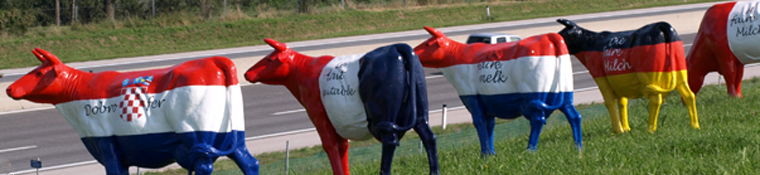


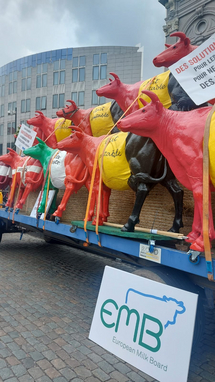
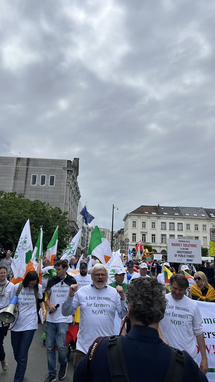
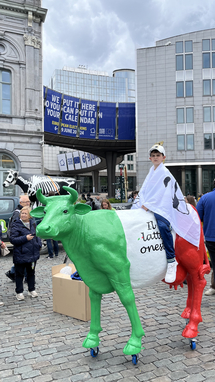
Brussels, 27 May 2024 - Farmer's delegations from all over Europe have gathered today at an impressive protest in the heart of Brussels to call for fairness in the agricultural sector. Under the slogan, “A fair income for farmers NOW!”, the participants presented their demands to the EU Agriculture Ministers meeting today, to the European Commission, the European Parliament as well as to other agricultural associations. As an umbrella organisation for European dairy farmers from over 15 countries, the European Milk Board (EMB) organised this important protest in the lead up to World Milk Day and the European elections. The protesters came with large statues of cows in their national colours - the Faironikas or Justines that symbolise the diversity and unity of the movement.
“We have been seeing farmer protests across Europe for months. It is clear: The agricultural system must be reformed,” says EMB President Kjartan Poulsen. As he underlines, the current discussions around solutions for the agricultural crisis do not clearly chart out what direction changes must take. “A fair agricultural sector, a fair income, that must be the goal of reforms. It is no longer enough to sidestep issues - we have to get to the root of the problem and bring about real changes,” adds the Dane.
His German college and EMB Vice-President Elmar Hannen uses income figures to clearly demonstrate the significant disadvantage and social misery faced by farmers in Europe. “If you look at farmer income, you can see how we have not even received 50 per cent of the EU average income for years. In fact, it was below 40 per cent in 2016 and it was only in 2021 that we reached the 50-per cent mark for the first time,” says Hannen. “Not only is this a serious imbalance, it is also a disaster for farmers and their families, and for European food security as well.” He adds that the upcoming European elections are yet another chance to instate social fairness, at long last. Producers are leaving the sector in droves. Young people are put off due to the lack of prospects and do not see any way of entering the agricultural production sector. “We at the EMB therefore urgently demand the conditions to stay in production and to allow new entrants into the sector. Policy-makers must create a framework for fair income along the value chain, so that cost-covering producer prices finally become a reality. Otherwise, everyone loses - the producers as well as our collective ability to produce sufficient food in the EU,” says Hannen. Cost-covering prices are also an essential pre-condition to successful environmental and climate measures.
EMB Executive Committee member Boris Gondouin from France knows first-hand that food production and social sustainability/fairness can go hand in hand. “In recent years, EMB members have pushed for more fairness in the sector in many ways - be it through their political work, proposing models that align with the ground reality and promoting cost calculations, or even through projects like Fair Milk which have been rolled out in a number of countries. We know that fairness is possible and we call for a Europe-wide commitment towards it. We appeal to the European Commission, the Parliament and the Council, as well as all other associations that fly the flag of representing farmers. If you say you represent farmers, you must do everything you can to defend their key interests!”
The bedrock of European food production is getting dangerously weak. Farmers across Europe have left their fields and barns today to come to Brussels with their national Faironikas and Justines to protest for fair remuneration. If the necessary reforms are not introduced at long last, many more colleagues will leave their fields and barns, not just for a day, but forever.
A fair income for farmers NOW!
The following reform measures must be implemented immediately:
1. An EU-wide regulation that prohibits prices that do not cover production costs
Why?
Something that is a given in other sectors – that costs are passed on and are reflected in prices – is not the case in many parts of the agricultural sector. The invisible hand of the market is very clearly and obviously pushing prices below cost levels. An EU Regulation prohibiting this shortfall would lead to stabilisation of the income situation and thus of production structures across the EU.
2. Suitable crisis instruments must be integrated into the EU agricultural system. This includes a functioning early-warning mechanism, built around the correct indicators that reflect real production costs, including appropriate producer income, where measures like voluntary production reduction/the Market Responsibility Programme are automatically activated.
Why?
On the dairy market, for example, each crisis has followed hot on the heels of the previous one in recent years. Overproduction led to a price collapse and forced many producers out of business each time. These crises can be avoided or mitigated if the right mechanism is activated in a timely manner and something like a volume reduction programme counteracts overproduction. This works, and has been proven by its implementation in 2016/2017 in the EU.
3. Specific EU contract clauses on, inter alia, volumes and cost-covering prices prior to milk deliveries. This must apply for all market actors, including cooperatives.
Why?
The market position of producers can only improve when contracts include the correct clauses. The unequal distribution across the value chain is a product of imbalances in market strength among different stakeholders. While processors and traders can ensure that their production costs are covered and, furthermore, that they earn significant profits through food products, production cost shortfalls are the norm at producer level.
4. Strong horizontal producer organisations that allow producers – including those in cooperatives – to pool together for a better negotiating position
Why?
Strong producer organisations are also strong negotiating partners when it comes to determining producer prices with dairies. However, an organisation can only be strong when it brings together a large number of farmers and negotiates with multiple dairies, i.e. it is horizontal. It is impossible for so-called vertical producer associations that are dependent on a single dairy to develop this strength.
5. Real involvement of producers in the design and implementation of the Green Deal, including creation of the right tools
Why?
Producers are currently not involved in drafting the Green Deal. The goals are simply announced to them and they are expected to bear the financial burden of these strategies with their already insufficient agricultural income. This has to change. Producers must be placed at the heart of agricultural strategies and must be appropriately involved in shaping them. Farmers are fundamental to climate change mitigation. The Green Deal must be used to reform the current system towards a socially-sustainable model.
6. Mirror clauses that ensure that imported food and feed stuffs comply with EU requirements. Furthermore, this compliance must be enforced through sufficient checks and sanctions.
Why?
The import of goods that are, for example, produced under less strict environmental conditions than EU products is harmful in a number of ways. On one hand, these goods can undercut EU producers due to lower production costs stemming from lower environmental compliance and can end up pushing EU products out of the market. These lower costs also promote offshoring of production outside the EU, which would lead to a greater environmental impact in these locations. These goods are consumed in the EU.
7. Promote and expand the Fair Milk project in the EU
Why?
Fair Milk shows the way forward. In this project, participating producers are paid cost-covering prices, which include a fair remuneration for them. Even though Fair Milk projects already exist in countries like France, Germany, Belgium, Luxembourg and Switzerland, they still do not reach enough consumers and producers. More producers should be able to benefit from the positive influence that Fair Milk has on their lives and income. The EU and each of its Member States can contribute to this by providing public recognition of Fair Milk.
Contacts:

Kjartan Poulsen – President of EMB (EN, DK, DE): +45 (0)212 888 99
Elmar Hannen – Vice President of EMB (DE): +49 175 6378484
Guy Francq – EMB Executive Committee Member (FR): +32 497 34 46 22
Silvia Däberitz – Director of EMB (FR, DE, EN): +49 (0)176 380 98 500
Luisa Aiglstorfer – EMB press office (FR, DE, EN): office@europeanmilkboard.org